Hours & Admissions
 Directions
VMNH Research & Collections Greenhouse
VMNH's Department of Archaeology is currently cultivating a number of plant species which were once very important to the Indigenous peoples who inhabited the land we now know as Virginia, as well as numerous other Indigenous peoples across both North America and Mesoamerica.
The main goal of this project is to successfully bring each of these specimens to seed so that we can incorporate their seeds into the Department of Archaeology's Archaeobotanical Reference Collection to assist future research and growing opportunities; preserving seed for both future propagation attempts as well as having seed examples to help identify macrobotanical remains found in archaeological contexts. To see what plants are represented in VMNH Archaeology's Archaeobotanical Reference Collection, Click here!
Many of these species or their relatives remain well known today for their importance in modern agriculture, while others are infamous as common agricultural and urban weeds.
Check below to see the full list of plants currently being grown by VMNH Archaeology in the Research & Collections Greenhouse!
*Greenhouse Updates Blog
-
To see the growth of our plants over time, click here!
The influence of advanced and widespread trading routes allowed for important crops and other useful plants to proliferate throughout the Americas. These species were traded and propagated by diverse groups of Indigenous peoples of different ethnic affiliations, with many groups coming to share the same core species of Mesoamerican-originating food and ritual plants.
In Eastern North America, as well as Virginia, Indigenous women were typically the farmers of food crops, with men helping clear the land before planting took place.
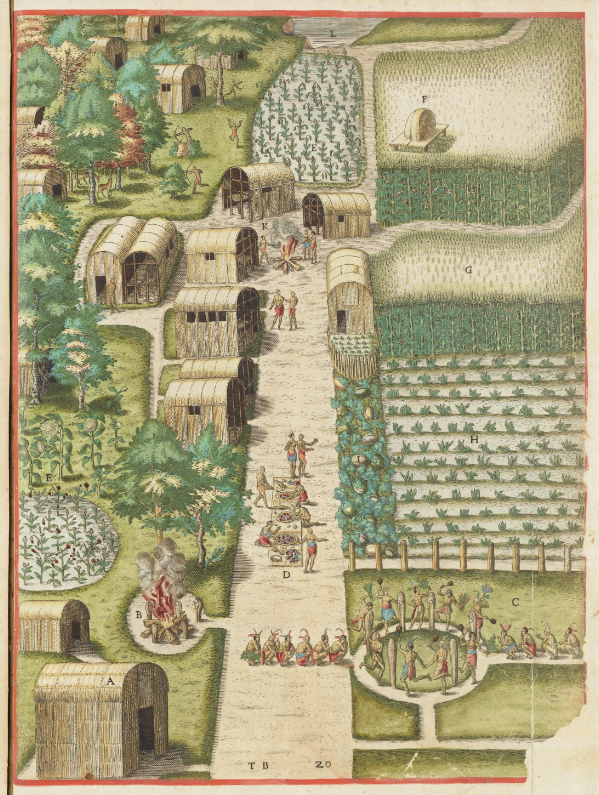
Colored engraving of "The Tovvne of Secota.", Theodor de Bry (1590) based on a John White watercolor ca. 1585-1587 (Hariot 1590 {1588}; Dukes 2024)
Inside R&C's Greenhouse, you will find a few of the many plants used by the Indigenous peoples who call this land home
These plants include... (Click on each to learn more!)
- Zea mays L. 'Tutelo Strawberry' -- Tutelo Strawberry Corn -- Family Poaceae
- Phaseolus vulgaris L. 'Hidatsa Red Indian' -- Hidatsa Red Indian Bean -- Family Fabaceae
- Cucurbita pepo L. var. ozarkana D. Decker -- Ozark Melon -- Family Cucurbitaceae
- Nicotiana rustica L. -- Sacred Tobacco/Indian Tobacco/Mapacho -- Family Solanaceae
- Datura stramonium L. -- Jamestown Weed/Thorn Apple -- Family Solanaceae
- Physalis longifolia Nutt. -- Longleaf Groundcherry/Wild Tomatillo -- Family Solanaceae
IN THIS GREENHOUSE... we are applying horticultural techniques to perform experimental archaeology to test small-scale cultivation of these plants which held a place of immense importance for the Indigenous peoples of Virginia. These plants are intended only for demonstrative and observational purposes and are NOT INTENDED for consumption. Under NO CIRCUMSTANCES should unknown plants be ingested, nor should plants with known toxic and potentially life-threatening characteristics be foraged or grown with the intention of being used irresponsibly.
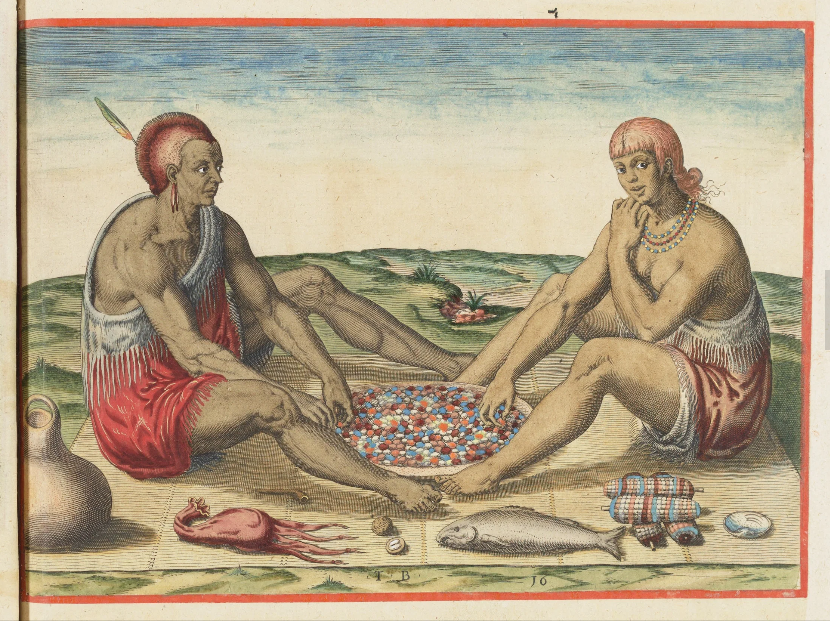
Colored engraving of "Their sitting at meate.", Theodor de Bry (1590) based on a John White watercolor ca. 1585-1587 (Hariot 1590 {1588}; Dukes 2024)
References
-
Dukes, H. (2024) Theodor de Bry’s Engravings for Thomas Harriot’s Briefe and True Report (1590). The Public Domain Review. Retrieved from: https://publicdomainreview.org/collection/briefe-and-true-report-de-bry-engravings/.
-
Hariot, T. (1590). A briefe and true report of the new found land of Virginia, of the commodities and of the nature and manners of the naturall inhabitants. Discouered by the English Colony there seated by Sir Richard Greinuile Knight In the yeere 1585. Which Remained vnder the gouernement of twelve monethes, At the speciall charge and direction of the Honourable SIR WALTER RALEIGH Knight lord Warden of the Stanneries Who therein hath been fauoured and authorised by her MAIESTIE and her letters patents: This fore booke Is made in English BY Thomas Hariot Servant to the abouenamed Sir WALTER, a member of the Colony, and there imployed in discouering. T. de Bry & G. van Veen (Engravers). Frankfurt am Main: Johann Wechel. In Library of Congress Online Catalog. (Original work published 1588). Retrieved from: https://www.loc.gov/item/48032384/.
-
Marsh, E. (n.d.). The Three Sisters of Indigenous American Agriculture. U. S. Department of Agriculture, National Agricultural Library. Retrieved from: https://www.nal.usda.gov/collections/stories/three-sisters.
-
Rountree, H. C. (1989). The Powhatan Indians of Virginia: Their Traditional Culture. Norman, OK: The University of Oklahoma Press.