Hours & Admissions
 Directions
Greenhouse Updates Blog
By: Aidan Lawrence, VMNH Archaeology Research Assistant & sole greenhouse grower
April 22, 2026
1:16 PM
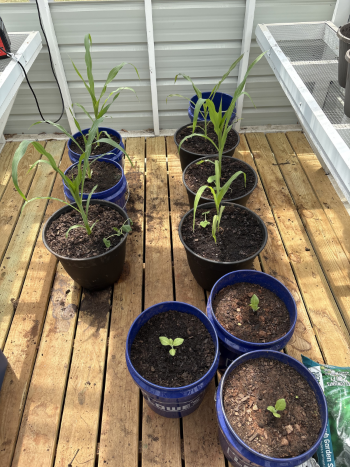
Picture taken roughly 20-30 days after planting seeds. Young Tutelo Strawberry Corn (Zea mays L. 'Tutelo Strawberry') plants were transplanted from the one container I started them in into six different ones. When the corn seedlings were about one-foot tall, 4 bean (Phaseolus vulgaris L. 'Hidatsa Red Indian') seeds were planted around each stalk. Three cucurbit (Cucurbita pepo L. var. ozarkana D. Decker; Ozark Melon) seedlings were found growing from material that was being composted and added to 3 of the containers. At least a hundred Sacred Tobacco (Nicotiana rustica L.) seedlings were started due to extremely small size of the seeds, but only 3 were transplanted into containers after thinning.
The soils in the containers for the 'three sisters' plants consisted of a mix of vegetable potting mix and gardening potting mix. The containers for the Sacred Tobacco included these potting mixes in lesser quantities as well as a large proportion of locally-sourced red clay. The plants were planted mostly in 5-gallon plastic buckets which I had drilled drainage holes into or plastic pots of a similar volume to the 5-gallon buckets; I have had lots of luck with 5-gallon bucket gardening at home, especially with tomatoes, proving very valuable for gardeners with limited spaces for growing. Organic mulch was also added to the containers around the plants' stems.
April 28, 2026
9:53 AM
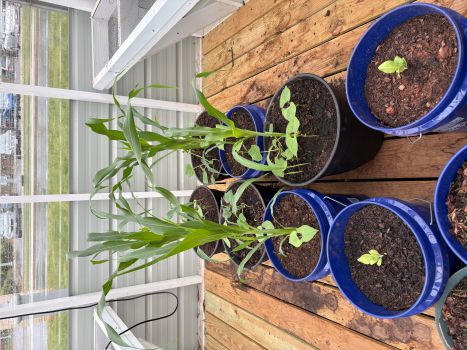
Continued growth of Tutelo Strawberry Corn stalks, Ozark Melon cucurbits, and Sacred Tobacco seedlings. Emergence of Hidatsa Red Indian bean seedlings before thinning.
May 1, 2026
3:19 PM
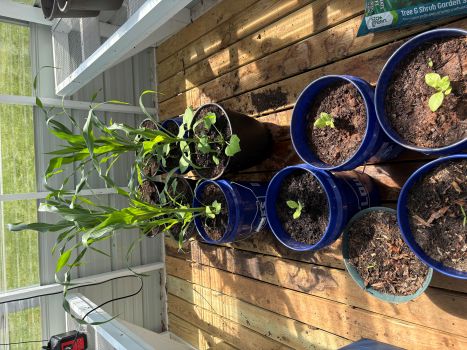
Tutelo Strawberry Corn stalks reached roughly two-feet in height. Hidatsa Red Indian bean seedlings thinned to two per container. Continued growth of Sacred Tobacco seedlings. Two containers at bottom left contain one Jamestown Weed (Datura stramonium L.) seedling each that I started from seed; these are barely visible due to the small size of the seedlings.
May 11, 2026
10:59 AM
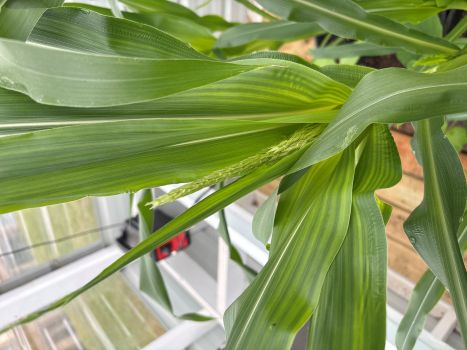
Appearance of emerging corn tassels (male inflorescences/flowers) at the top of one of the Tutelo Strawberry Corn stalks.
May 18, 2026
9:11 AM
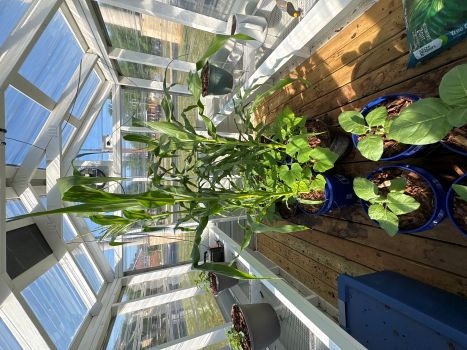
Tutelo Strawberry Corn stalks have reached roughly four-feet in height, all six are beginning to develop tassels (male inflorescences/flowers) that emerge from the tops of each plant. Hidatsa Red Indian bean seedlings thinned to one plant per container, and have begun to twine around and climb the corn stalks. Ozark Melon cucurbit plants are starting to sprawl. Continued growth of Sacred Tobacco and Jamestown Weed plants. Addition of two Longleaf Groundcherry/Smooth Groundcherry (Physalis longifolia Nutt., most likely Physalis longifolia Nutt. var. subglabrata (Mackenzie & Bush) Cronq.) plants started by me from seed.
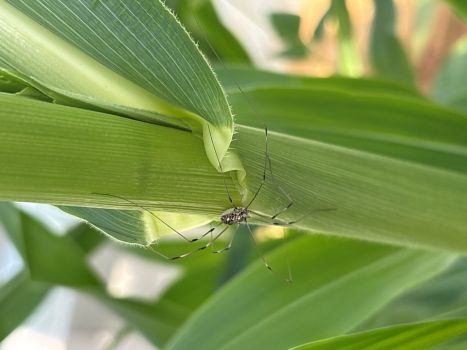
A group of half-a-dozen or so Eastern Harvestmen (Leiobunum vittatum Say) have moved into the greenhouse, often called 'daddy long-legs', these omnivorous arachnids are harmless to humans but highly beneficial to gardens since they eat common pest insects like mites and aphids, as well as decaying plant matter.
May 19, 2026
9:15 AM
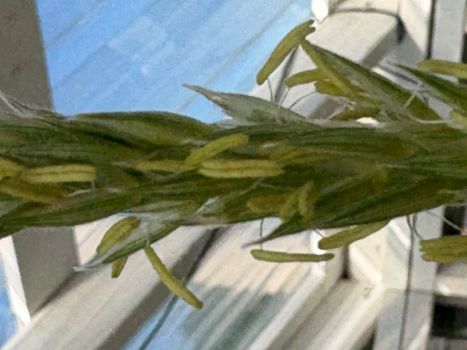
First emergence of tassel flowers on Tutelo Strawberry Corn stalk, each one of the yellow ovals (which are individual male flowers) releases thousands of grains of pollen, only one grain of which is required to land on a silk (female inflorescences/flowers) in order to pollinate it.
May 20, 2026
9:08 AM
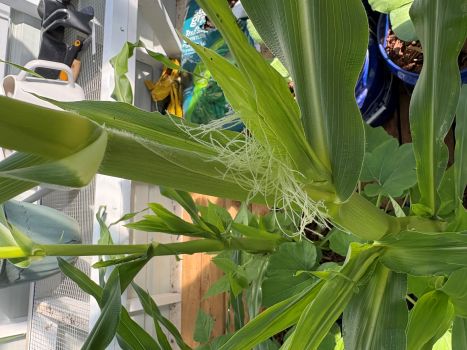
First emergence of corn silks (female inflorescences/flowers) on a Tutelo Strawberry Corn stalk, each individual 'silk' strand pollinates one kernel on a cob of corn; I began hand-pollinating the silks using a brush to collect pollen from the tassels and applying it to the silks, as well as encouraging pollen dispersal by gently shaking the stalks.
May 26, 2026
9:41 AM
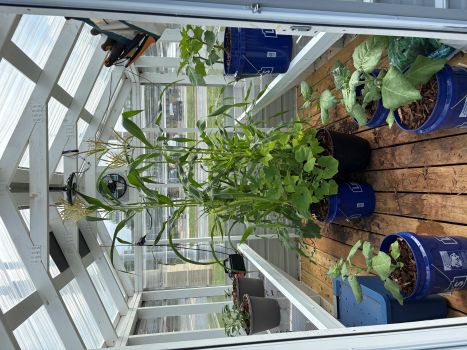
Tutelo Strawberry Corn stalks are over five-feet tall; about 10 individual cob silk-clusters emerging in total at this time with evidence of others on the way. Corn tillers (suckers that emerge from the stalk's base at 45° angles) are up to two-feet tall and some are showing signs of tasseling (male inflorescences/flowers). Hidatsa Red Indian beans are beginning to flower and most are nearly half-way up the corn stalk that they are climbing. Ozark Melon cucurbits are developing more blossoms and one male flower opened; their vines are sprawling vigorously, expanding outside of their containers and onto the floor of the greenhouse--one thing any prospective 'Three Sisters' gardener should know is that this form of companion planting is aesthetically 'messy', the plants are creating a dense little jungle among themselves but with their specific habits of growth that do not impede one another, they will bring lots of food in the end...hopefully. Sacred Tobacco plants are just about two-feet tall and are beginning to put out emergent blossoms from the main stalk with at least one flower having opened, there is evidence of suckering as well--though some ethnohistoric accounts mention that Indigenous peoples suckered (removed the suckers from) their tobacco, I am not going to since this species of tobacco really likes to sucker and you get more flowers this way. One of the Longleaf Groundcherry plants wilted significantly after a heat wave, and I pruned it to one main stalk which is still alive; the other is exhibiting early signs of blossoming.
May 28, 2026
1:44 PM
Temperature inside Greenhouse: 96° F (35.6° C)
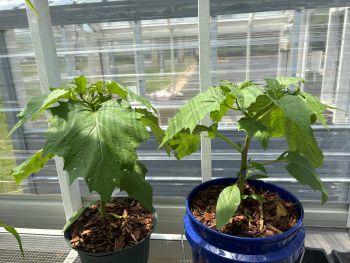
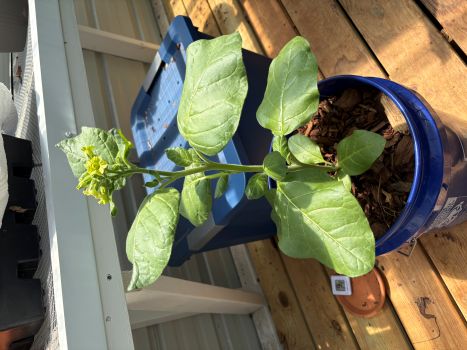
The Jamestown Weed plants are growing very stout stems and large leaves, they dropped their initial blooms which had been forming but more are appearing among the younger leaves at the tops of the plants. One of the Sacred Tobacco plants has at least 10 open blooms with more emerging, the other two plants are not far behind.
May 29, 2026
2:42 PM
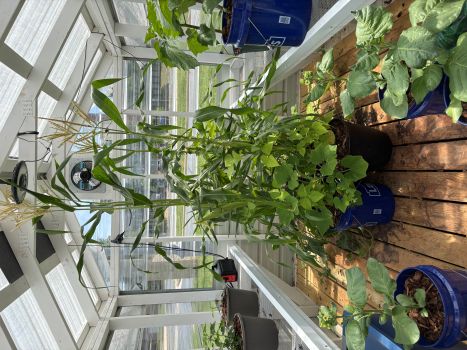
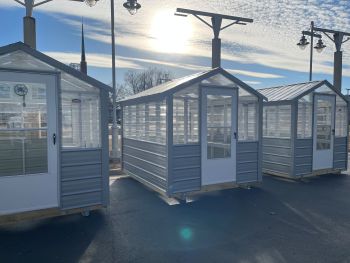
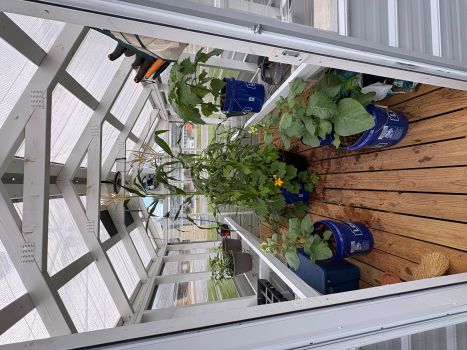
Installed new shade cloth over greenhouse with the help of VMNH Archaeology's Madison Ross to shield the plants from the extreme heat that often occurs due to lack of natural shade and being located in a hot parking lot. Temperatures inside the greenhouse on a hot, sunny day could reach as high as 130° F (54.4° C) and often did before the installation of the shade cloth, even in fall and spring, and other measures have been implemented to limit excessive temperatures.
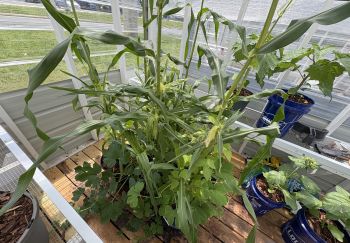
Continued hand-pollination of corn silks (female inflorescences/flowers) on Tutelo Strawberry Corn stalks, beginning of bean pods forming on Hidatsa Red Indian bean plants, and more Ozark Melon cucurbit blossoms emerging. Two of the three Sacred Tobacco plants are now flowering and the larger of the Longleaf Groundcherry plants has begun flowering as well. The corn plants are roughly six-feet tall or so, the tallest of the stalks have begun to reach the ceiling of the greenhouse but thankfully it is only the spent and old tassels (male inflorescences/flowers) so it is unlikely they are going to grow much taller, but at least one has begun to bend slightly to accommodate the shorter headspace.
I am typically watering the 'three sisters' containers every day, especially while the corn stalks are in the silk and ear-forming stage, while the Jamestown Weed and Sacred Tobacco are typically being watered every other day. The Longleaf Groundcherries I have been giving some water everyday as they continue to get established, especially the one plant that had been struggling. Everything gets a deep watering on Fridays since I am not in on the weekends, and I have not yet noticed any detrimental consequences to the plants on this watering regimen.
June 1, 2026
9:42 AM
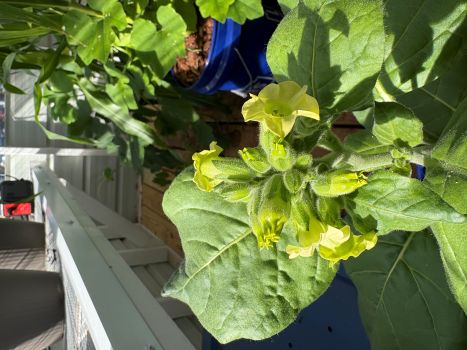
Continued flowering of two of the Sacred Tobaccos, the Hidatsa Red Indian beans, and Ozark Melon cucurbits as well as the larger of the Longleaf Groundcherry plants. The corn tillers (suckers) on most of the Tutelo Strawberry Corn stalks have also begun to put out both tassels (male inflorescences/flowers) and in some cases silks (female inflorescences/flowers), and in one case female silks emerging from a cluster of male flowers. I have begun checking some of the corn leaves for earwigs (most likely the European Earwig (Forficula auricularia L.)) and removing them, as well as the Sacred Tobacco plants on which I have also found earwigs.
June 2, 2026
1:25 PM
Temperature inside Greenhouse: 81° F (27.2° C), outside temperature: 71° F (21.7° C)
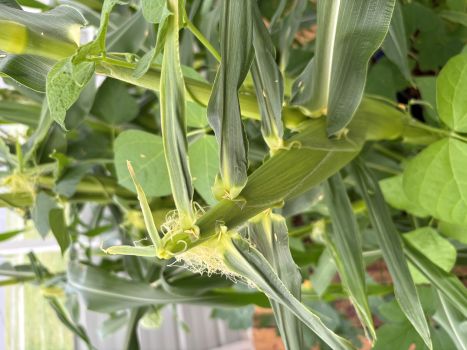
One of the ears of corn as it is forming on a Tutelo Strawberry Corn stalk. See also the twining bean vine as it climbs this corn stalk, recognizable by its trifoliate leaves (compound leaf with three leaflets emerging from a single stem).
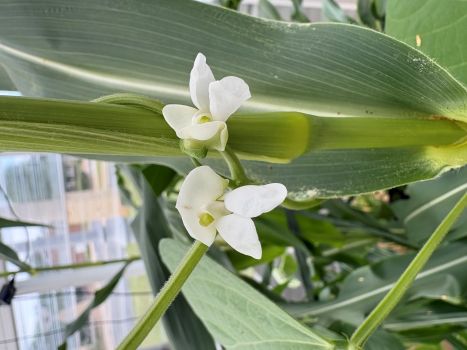
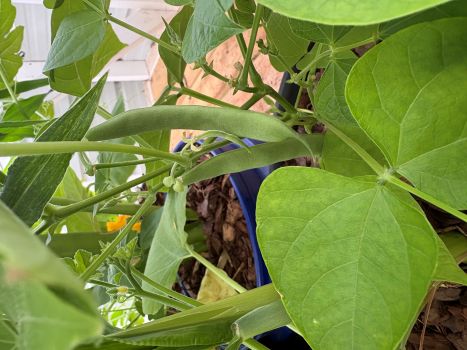
Hidatsa Red Indian bean flowers towards the top of the corn stalk and bean pods towards the bottom of the same corn stalk. Bean flowers mostly self-pollinate before the flowers even open, but since I have shaken the corn stalks to disperse pollen, it has probably also helped the beans to pollinate as well.
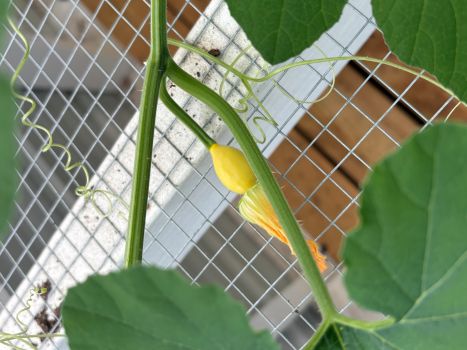
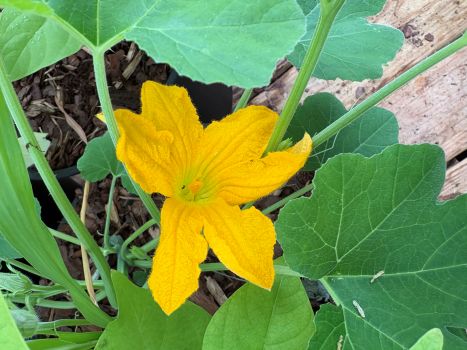
One of the female inflorescences (flowers) on one of the Ozark Melon (C. pepo L. var. ozarkana D. Decker) cucurbit vines. Though I did not hand-pollinate any of the female flowers with pollen from a male flower, apparently some insect within the greenhouse has done this for me since the flowers appear pollinated and the fruits are already growing; this was likely done by small ants, of which I have found many within the other open cucurbit flowers.
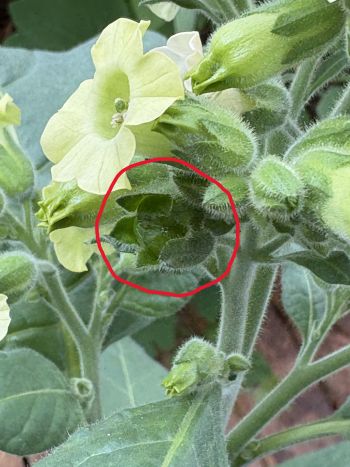
Evidence of a pollinated Sacred Tobacco flower beginning to form a seed pod. Tobacco plants mostly self-pollinate, so I gently shake the plants in the morning with a gloved hand to encourage pollination; the glove is necessary to prevent accidentally absorbing a lot of nicotine through my skin. Each of the flowers will form a seed pod like the one pictured and each of these will contain hundreds of very small seeds, with one plant capable of producing hundreds of thousands of seeds.
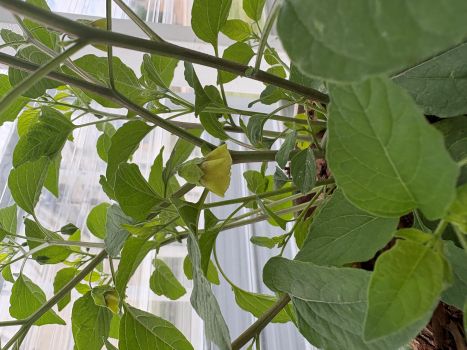
Downward-hanging flowers of Longleaf Groundcherry. Longleaf Groundcherry benefits from pollinators, but can also self-pollinate; to assist this plant with the lack of pollinators (like bumblebees) in the greenhouse, I have been gently shaking the plant and the flowers to help it set fruit, which are a small cherry-tomato-like edible berry enclosed in a papery husk like a tomatillo.
June 3, 2026
2:18 PM
Temperature inside Greenhouse: 84° F (28.9° C), outside temperature: 77° F (25° C)
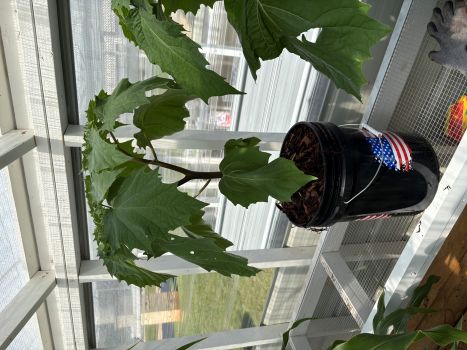
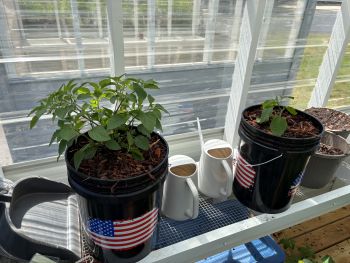
Repotted the Jamestown Weed plant that was in the smaller container into a 5-gallon bucket like the other one is in due to the former plant's leaves continually drooping. Also repotted the two Longleaf Groundcherry plants into 5-gallon buckets just to allow them to grow larger than they probably would have in the smaller containers that they were in; I have had great success growing Longleaf Groundcherries in 5-gallon buckets at home.
June 16, 2026
1:16 PM
Temperature inside greenhouse: 94.3° F (34.6° C), outside temperature: 77° F (25° C)
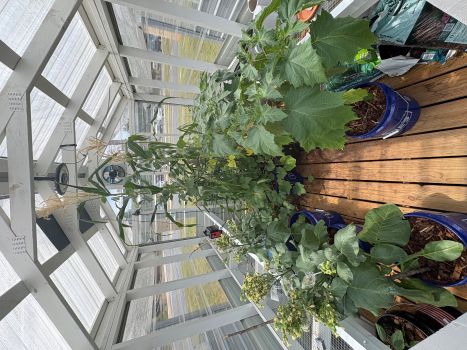
Temperatures have soared recently with little reprieve. Daytime highs are often approaching 90° F (32.2° C) and that has meant more stress on the plants since the greenhouse is often much warmer that the ambient air temperature. As the plants grow larger and expend more of their energy towards seed production, watering heavily has become critical during this period or else I have been faced with extreme wilting. The plants often perk back up after a deep watering when they have wilted but I try to limit just how often that occurs, usually it happens on the weekend when I am not at the museum. The temperature and water stresses have caused some blossoms and budding fruit to fall off, notably on the Jamestown Weed and the Ozark Melon cucurbit vines, with some Sacred Tobacco seed pods also dropping. The foliage of the Tutelo Strawberry Corn has begun yellowing in places, but it is hard to say what is causing this: it could be a combination of reallocating energy expenditure on ear production, need for water, or need for nutrients like Nitrogen. However, the ears are developing nicely it seems (see pic below). Some of the Hidatsa Red Indian Bean pods have begun yellowing as well and are becoming more taut as the beans inside become increasingly visible, which is a sign that they are maturing. The bottom leaves of most of the bean vines have begun to yellow and die which is a natural occurrence, but some of the upper leaves have a gnarled appearance that I am attributing to a combination of insufficient watering and extreme temperatures that occurred last week, but I have not noticed any catastrophic die-off and they seem to be recovering.
I have moved things around, giving the greenhouse a very cluttered appearance (more so than it already was). The Jamestown Weed plants are now on the floor of the greenhouse because I believe that the sun directly hitting the containers they were in was causing heat stress on the roots and leading to a constant wilted appearance, and, the Longleaf Groundcherries are now under the shelves on the left side of the greenhouse floor where they get dappled light since similar problems were arising with those as with the Jamestown Weed.
When I came in on Monday, I noticed that a corn stalk and two of the Sacred Tobacco plants had been blown over, probably due to a very windy day on Sunday that also gave me issues with my tomato plants in containers at home. Thankfully, the plants were still alive and I staked them up to set them upright again and they appear to be doing fine now.
As of now, I can only water and manage circumstances as I can, that means lots of watering and limiting how many days the plants go without being watered. Everything appears to be hanging on, which is all I can ask of them. This experiment has proved very gratifying but the conditions and placement of the greenhouse are limiting factors on how well the plants can perform, not forgetting the very high temperatures we have been getting lately. An actual irrigation system and an increased or upgraded ventilation system would absolutely be necessary if we grow again next year, and it might be worthwhile to look into relocating the greenhouse out of the sweltering, heat-trapping parking lot that has no shade trees; the lack of trees is exacerbating high afternoon temperatures. I was also having to lug the watering cans inside the museum, making a couple trips every day, just to keep the plants watered, but now I have four plastic water gallon-jugs from the store that allow me to more easily transport water to the greenhouse without it spilling like the watering can used to. The one plus side of the maximum sun exposure that the greenhouse's current location affords is that the plants are growing very rapidly, farther along than even I thought they would be for the time of year, and perhaps in the next month we may see some that are already ready to be harvested, like the Sacred Tobacco, the Tutelo Strawberry Corn, and the Hidatsa Red Indian Beans. Since container grown plants are more prone to drying out or being deficient in nutrients, I have been applying an all-purpose fertilizer (miracle-gro plant food) roughly once a week, especially in a crucial stage such as now when the plants are using lots of their reserved nutrients to set fruit and seed.
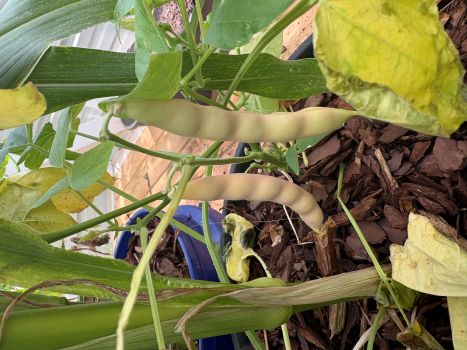
Same bean pods as shown in the picture from 6/2/26, you can see how they have begun yellowing and the pods themselves have grown more taut around the beans they're holding; these two pods hold a total of 11 beans. You can also see evidence of foliage die-back as evinced by the yellowing leaves, but the tops of the plants are still green. It is likely that the lower pods will mature long before the pods that are higher up on the plant, but they will all be harvested at the same time when all of the pods are dry and the bean vines themselves die.
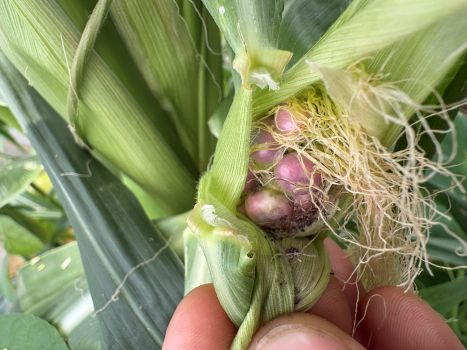
A small ear of Tutelo Strawberry Corn whose husk was not entirely closed, you can see the signature pinkish-red color of the kernels beginning to show, indicating successful pollination. Once the stalks completely die and dry out the ears of corn will be ready to be harvested.
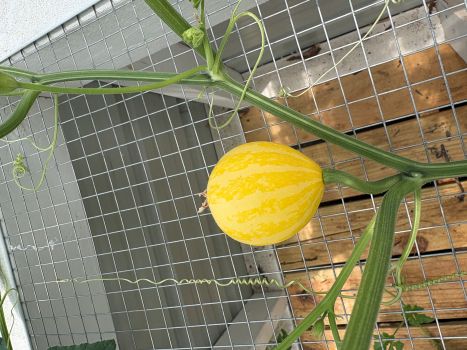
Following the extreme heat of last week, only one of the Ozark Melon cucurbit fruits managed to hang on, and it proved to be the same one shown in the picture from the post on 6/2/26. Clearly, this vine was putting all of its effort into maintaining the growth of this one cucurbit since it sensed that it was its best chance to produce viable seeds. The fruit clearly resembles the cucurbits given to us by Wood Thrush Native Nursery in Floyd, VA, showing that our plants growing in the greenhouse did in fact come from those and are C. pepo L. var. ozarkana D. Decker.
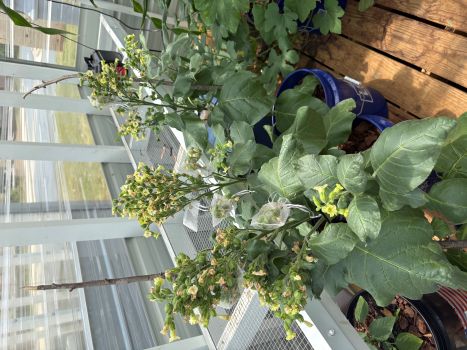
The Sacred Tobacco plants have spent most of their blossoms and it is evident that there are lots of seed pods. Some seem much farther along than others and some show evidence of nearing maturity (i.e. pods are browning and getting harder). The extreme temperature has caused some of these pods to die off and drop, but, this is not widespread and shows that the plants are strategically focusing energy into successfully developing the most viable pods, or at least those that were farther along and were likely to reach maturity first. When they reach maturity there will likely be a period where the pods remain closed but eventually they will open to disperse their seeds. I do not think I will miss this, but, just in case, I have enclosed some of the seed pods with drawstring mesh bags to capture any seeds if they do in fact open before I am able to collect them.
June 24, 2026
1:46 PM
Temperature inside greenhouse: 88° F (33.1° C), outside temperature: 81° F (27.2° C)
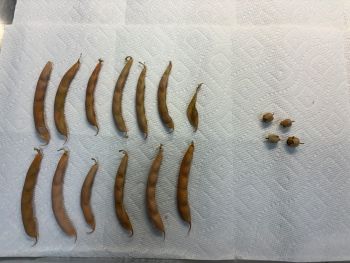
Our first seed collections! Today, 13 Hidatsa Red Indian bean pods and 4 Sacred Tobacco seed pods were sufficiently ripened to be harvested. This is typically done at the end of the season but with variable humidity and other conditions within the greenhouse, I thought it would be best just to harvest those pods that are ripened fully and to let them dry out completely inside before being processed; i.e., removing the seeds from their pods in roughly one-to-two weeks and letting them sit out and dry for another couple of weeks before storing them in an airtight container.
In terms of expected harvest, I think that the beans and tobacco will be the largest share of the seeds harvested, due simply to how prolific they are. The Tutelo Strawberry Corn I expect will come to ripeness but I do not have much hope for full, pretty ears like some pictures show. With spotty pollination and so few plants, it is very likely that there will not be that many ripe kernels on the corn cobs that we have growing. One of the corn stalks, the one that had to be staked up rather severely since it appears to be the weakest plant, is looking like it's about to die and is yellowing quite drastically, while the others are yellowing more gradually. I have been feeling the ears of the corn that I can reach and definitely feel some maturing kernels under the husks but I think that many of the kernels are unpollinated and will show once I harvest them.
The Jamestown Weed plants keep shedding their blooms before they are able to flower, indicating what I suspect to be heat-related stress, but there is not much that can be done about this condition and I can only hope that eventually the plants power through, flower, and set seed. There are more Ozark Melon fruits beginning to grow, but with increased temperatures in the coming weeks it will be hard to know for certain if the plants will keep these or lose them due to external conditions and stress, however, the one fruit previously shown that is growing quite large is my best hope right now for a ripe cucurbit off of these plants. I have been hand-pollinating the Longleaf Groundcherry flowers and have set a few fruits on these plants, but it is hard to say when or if these will come to full maturity.
Besides Longleaf Groundcherry and Sacred Tobacco, I personally have never grown any of these other plants before. The last Sacred Tobacco plants I grew did not make it to seed before cold weather killed them, so, really I have only successfully grown Longleaf Groundcherry before this experiment. I am honestly pleasantly surprised at how successful the plants have been so far, disproving most of, but not all, my reservations about cultivating in the VMNH R+C greenhouse. It is definitely possible, that's for sure, but maybe not ideal under current conditions. I tell myself, though, that this is, above all, a learning process to guide future cultivation attempts.
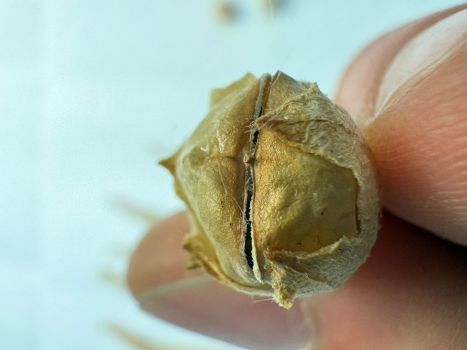
Closeup of a ripe seed pod of Sacred Tobacco. Whereas the immature pods are vibrantly green and firm to the touch, the ripe pods are papery and thin and when the seeds are mature will rattle like a maraca when shaken. You can see the beginning of the dehiscing process these pods undergo to spread their seeds via the wind, it is beginning to open along the distinctive horizontal slit that bisects the pod.
June 26, 2026
1:27 PM
Temperature inside greenhouse: 93.7° F (34.3° C), outside temperature: 88° F (31.1° C)
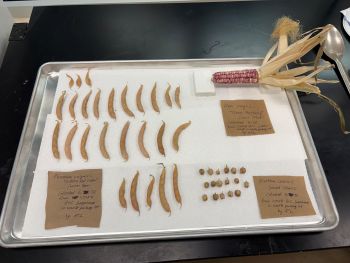
Current greenhouse harvest as of today: 26 Hidatsa Red Indian bean pods, 17 Sacred Tobacco seed pods, and one ear of Tutelo Strawberry Corn. It is so gratifying to know that at least this corn cob, and hopefully others, benefitted from my hand-pollinating and developed full, healthy kernels. I am a little worried about how effectively it will cure being inside but I am just hoping that being inside won't hurt the kernels and they won't mold or cure insufficiently. This ear came from the stalk that is practically dead, but none of the others are quite that far along, though the husks surrounding some of the other ears are starting to turn brown as well. Bean pods are continuing to ripen and form, and the same can be said for the Sacred Tobacco plants and the Longleaf Groundcherries. But, on the Ozark Melon cucurbit vines there is still only the one viable fruit and the Jamestown Weed plants are still not keeping their emergent blossoms. Temperatures are projected to get hotter in the coming week so I imagine that the heat wave will exacerbate most of the plants' reaching full maturity if they were already beginning to set ripe seeds.
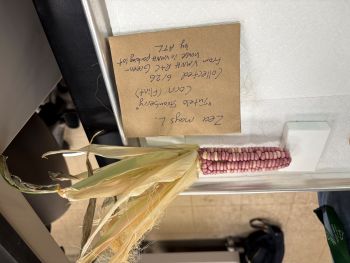
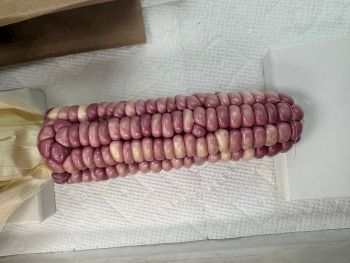
Closeups of the ear of Tutelo Strawberry Corn harvested by me today. You can see the distinctive reddish-pink hue of the kernels that helps give this heirloom variety its name.
July 1, 2026
10:47 AM
Temperature inside greenhouse: 95.7° F (35.4° C), outside temperature: 89° F (31.7° C)
Harvesting within the greenhouse continues, every few days getting a few Hidatsa Red Indian bean pods, some Sacred Tobacco seedpods, and Tutelo Strawberry corn as the stalks begin yellowing and dying. We are expected to have temperatures this weekend top out around 100° F (37.8° C), so I am not too hopeful that the plants will survive since the greenhouse internal temperature will likely be around 120° F (48.9° C). Thankfully we have harvested some seeds from the greenhouse plants before this extreme heat dome commences.
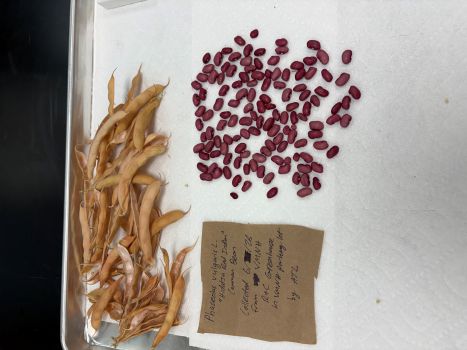
Shelled Hidatsa Red Indian beans from our harvested pods so far.
It seems apparent to me that the Jamestown Weed plants in the greenhouse are not going to reach their flowering stage due to the high temperatures within the greenhouse. Thankfully, I had an extra seedling when I started the seeds and have brought this plant to maturity at home, also grown in a 5-gallon plastic bucket. Below is a series of pictures showing how these plants' flowers bloom in the afternoon, reaching their fully-open state just before sunset and staying open through the night to attract night pollinators like moths before closing in the morning once being pollinated.
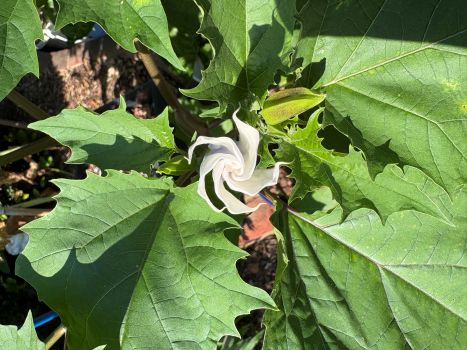
Jamestown Weed blossom at 4:46 PM, June 30, 2026
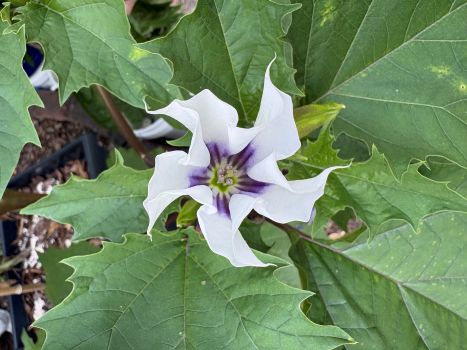
Jamestown Weed blossom at 5:37 PM, June 30, 2026
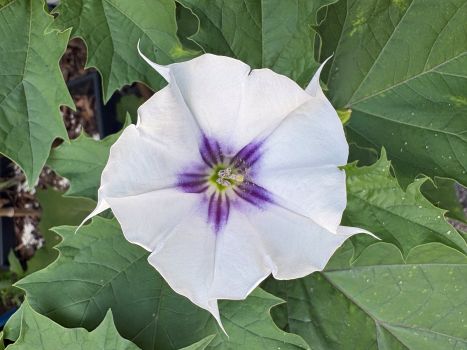
Jamestown Weed blossom at 7:31 PM, June 30, 2026
July 31, 2026
11:19 AM
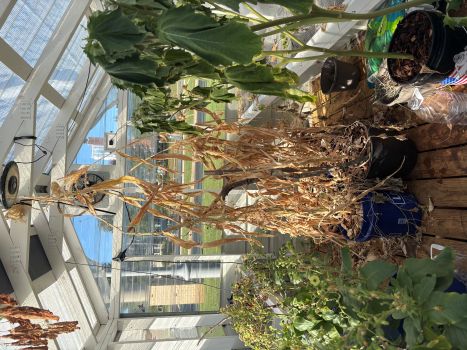
Growing operations in the greenhouse have mostly ceased for the season. As you can see from the image, the Three Sisters plants have mostly dried up and died, the Tutelo Strawberry Corn and Hidatsa Red Indian Beans being fully harvested and reaching the end of their life cycles; the Ozark Melon Cucurbit vines produced only one viable fruit between them and succumbed to high heat. The Jamestown Weed plants are not going to produce any flowers or seeds due to the greenhouse heat and are hanging on in a wilted and stunted state and will likely continue shedding leaves until they die too. The Sacred Tobacco plants are still alive and seem to be doing alright; I have been continuously harvesting seed pods from all three when individual seedpods ripen and have even harvested some leaves from them to cure and dry as display pieces for future exhibits (some can be seen in the top left of the above picture). There is only one Longleaf Groundcherry plant alive and it seems to be thriving, however, fruit set is pretty low and I do not foresee it actually surviving through to harvest time since I am going to be out of the office for a couple weeks coming up; I have been hand-pollinating its flowers with a paint brush when possible, but I do not know how successful this has been in the absence of pollinators and extreme heat.
Well, this has certainly been a very interesting, fulfilling, and sometimes frustrating endeavor. I am thankful to have been able to bring one of my interests and hobbies into the work fold, and to have success with it, too, was very gratifying. This experiment has definitely informed future growing endeavors, what will work growing in the greenhouse, what will not work, what to expect, and how our conditions affect the growth cycle of certain plants. I am thinking that leaving the yellowing stalks in the greenhouse will provide some winter interest and with our signage on the greenhouse will provide a visual and tangible aid to any who may read it and want to see the results of our labor in out-of-season months. A sign providing a QR code to this website page has been placed on the greenhouse door as well as in the archaeology lab window, which may help museum visitors realize the greenhouse is on premises and viewable and provide them with more information about the greenhouse growing process this spring and summer as well as further knowledge about Indigenous practices and ethnohistorical accounts that reference these plants.
I am working on processing the resultant produce from the greenhouse, measuring and counting corn kernels and beans, collecting tobacco seeds, cleaning squash seeds and shell pieces for reference collection inclusion. I will include a later update showing the full range of what was collected from the greenhouse, but the plant-growing section of this season's blog is pretty much over.
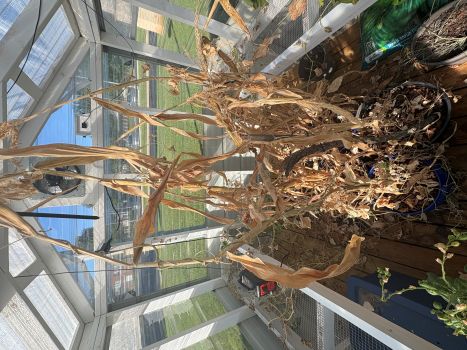
Withered Three Sisters pots; the Ozark Melon Cucurbits had some green left, as did the Hidatsa Red Indian Bean vines, however, their flowering had long since ceased and keeping them watered is no longer necessary.
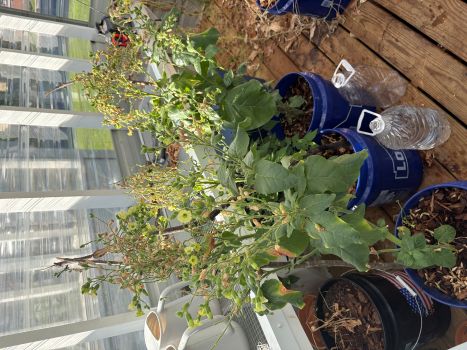
Sacred Tobacco plants still showing signs of flowering, but exhibiting heavy leaf defoliation and seedpod removal by me; leaves are beginning to yellow and brown. In bottom left of image you can see the dead Longleaf Groundcherry that did not make it.
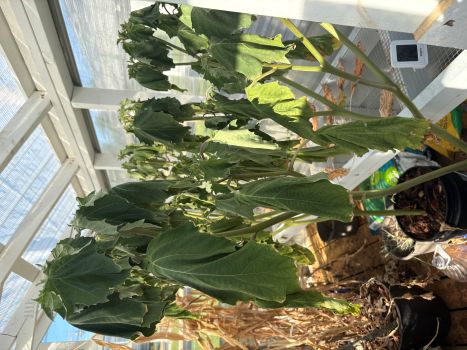
The Jamestown Weed plants have looked like this for over a month; the leaves do not perk back up even after watering and have been yellowing and dropping beginning from the bottom of the plant and traveling up, no flowers have emerged and the buds continue to drop.
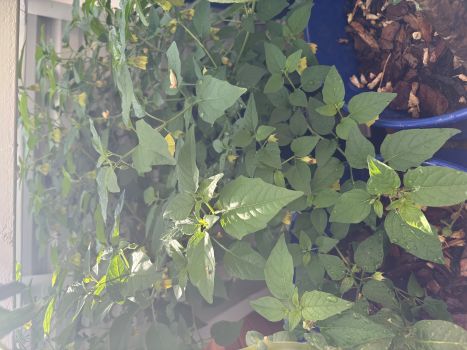
The one surviving Longleaf Groundcherry plant still looking very good and flowering; no forming fruits are visible in this image and fruit set has been very low for as many flowers as there are.
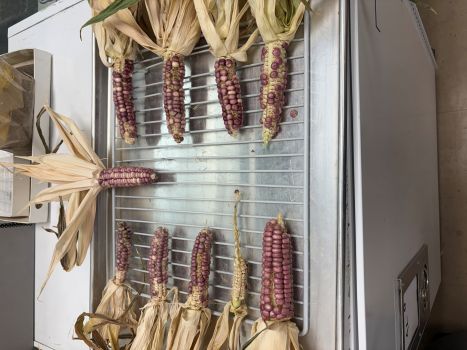
All of the Tutelo Strawberry Corn cobs harvested from the six stalks in the greenhouse; kernel coverage is very inconsistent as is evident from the image, some being full or practically full while others are practically bare.