Hours & Admissions
 Directions
Pumpkins/Squashes/Gourds
Pumpkins/Squashes/Gourds (Cucurbits) of the Family Cucurbitaceae (Cucurbita spp L. or Lagenaria siceraria (Molina) Standl.) were one of the 'Three Sisters' of Indigenous agriculture, a system of companion planting practiced and perfected by numerous Indigenous cultures throughout Mesoamerica and North America for millennia. In the area encompassing the Eastern United States, archaeological evidence points to the beginning of 'Three Sisters' agriculture emerging via trade route-inspired diffusion in the Late Woodland Period, roughly around the year 1000 CE (Gremillion 1995: 12). However, archaeological and archaeobotanical evidence has shown that there were at least two separate introductions of cucurbits into the region of the modern Eastern United States, one coming from Mesoamerica as with corn and beans, these being larger field pumpkin types, while smaller varieties--such as pattypan squashes--were bred from a cucurbit vine (Cucurbita pepo L. var. ozarkana D. Decker) native to the Ozarks region that had been domesticated in the Mississippi River Basin around 3000 BCE and had spread eastward through trade networks, predating the introduction of traditional Three Sisters agriculture by hundreds if not thousands of years in the region of the modern Eastern United States (Cameron 1996: 52-53; Smith 2006: 12225; Price 2009: 6427).
This early-introduced cucurbit made up part of the original domesticated agricultural complex that was practiced by Indigenous peoples in this region before the introduction of corn and beans that was termed the Eastern Agricultural Complex, which consisted of: Pitseed Goosefoot (Chenopodium berlandieri Moq.), Sumpweed (Iva annua L.), Sunflower (Helianthus annuus L. and Helianthus spp. L.), Maygrass (Phalaris caroliniana Walter), Erect Knotweed (Polygonum erectum L.), and Giant Ragweed (Ambrosia trifida L.). Most of these plants, besides sunflowers and C. pepo var. ozarkana, reverted to a weedy status because corn and beans were much more reliable, prolific, and easier to process food crops and most of the Eastern Agricultural Complex crops were subsequently forgotten (Gremillion 2004: 216). The Eastern Agricultural Complex is now considered to be one of the ten major centers of primary plant domestication in the ancient world and occurred in the Mississippi River Basin near the Ozark Mountains, west of the Appalachian Mountains (Price 2009: 6427). In modern-day Missouri, Kentucky, Tennessee, Illinois, and Arkansas, archaeobotanical evidence found at numerous archaeological sites has led to the discovery of members of the Eastern Agricultural Complex whose seeds exhibit signs of domestication and which have been radiocarbon dated as far back as roughly 3000 BCE, but wild usage of these plants has been found to date to nearly 6000 BCE (Fritz 1999: 418; Smith 2006: 12226; Price 2009: 6427). At the Magic Waters Site (31JK0291) in Jackson County, North Carolina, members of the Eastern Agricultural Complex were discovered in contexts dating to between 200 BCE and 200 CE and were likely in Virginia by this time (Santana 2022: 55-56).
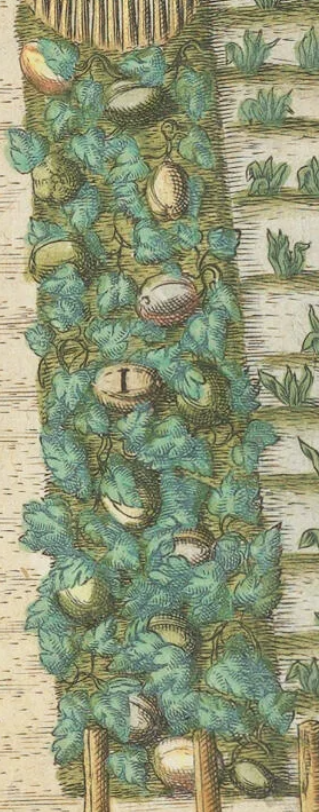
Cucurbit patch, detail of colored engraving of "The Tovvne of Secota.", Theodor de Bry (1590) based on a John White watercolor ca. 1585-1587 (Hariot 1590 {1588}; Dukes 2024).
'Three Sisters' agriculture consisted of planting Maize/Corn (Zea mays L.) kernels in mounds that were created in fire-cleared fields, often in clusters of up to four stalks or more. Among the growing corn stalks, seeds of climbing beans would be sown, providing a sturdy trellis on which for them to climb, as well as bracing and helping the corn stalks remain upright in high winds. Corn plants are heavy nitrogen feeders, and beans just so happen to be nitrogen fixers via bacteria that colonize their root systems and sequester atmospheric nitrogen in the soil in forms more readily usable like ammonia, which helps to provide the nitrogen needed by corn plants. Pumpkins/Squashes/Gourds (Cucurbita spp. L. or Lagenaria siceraria (Molina) Standl.) would also be planted in between the corn and bean mounds to provide shade to the soil with their large leaves in order to help the soil retain moisture and to shade out weedy species from being able to thrive and compete with the crop plants. The biological mechanisms of companion planting were unknown at the time, but the benefits were observed and refined by Indigenous peoples over thousands of years, oftentimes with them selectively breeding landrace, local varieties of these crops over long periods of time which were well-suited and adapted to the climates in which they lived (Marsh n.d.). Indigenous cucurbit varieties came in all sorts of colors and sizes and particular groups of Indigenous peoples often developed certain landrace varieties over time which came to be associated with their particular cultures.
The variety of cucurbit growing in the greenhouse is C. pepo L. var. ozarkana D. Decker, which is believed to have been the wild progenitor of the domesticated cucurbits which were a part of the Eastern Agricultural Complex and from which was derived familiar varietals like the pattypan squash as well as other small ornamental pumpkins/gourds often found in stores in autumn and fall (Fritz 1999: 419-420; Smith 2006: 12225-12226). Indigenous peoples initially consumed only the seeds of cucurbits since wild and early varieties contained bitter flesh and had thin skins, however, as domestication continued and continual breeding occurred, thick-skinned varieties with edible flesh emerged which were often boiled and eaten--oftentimes in walnut milk by the Powhatan--as well as being dried in the sun for winter use; the seeds were also still eaten (Hussey 1974: 318-319; Rountree 1989: 52; Cameron 1996: 52-53). Also, gourds were often used as storage vessels, but also fashioned into dishes, spoons, ladles, funnels, tobacco boxes, cups, or flagons; the species most often used by Indigenous peoples for these purposes was the Bottle Gourd, or Calabash (Lagenaria siceraria (Molina) Standl.) (Rountree 1989: 53, 63).
Four ripe Ozark Melon cucurbits were received from Wood Thrush Native Nursery in Floyd, VA and it is from one of these cucurbits that the seeds which sprouted and became our greenhouse specimens came from.

Gourd vessel, detail of colored engraving of "Their sitting at meate.", Theodor de Bry (1590) based on a John White watercolor ca. 1585-1587 (Hariot 1590 {1588}; Dukes 2024).
Ethnohistorical Accounts
*NOTE: These quotations from early English colonists represent some of the only information written down about Indigenous lifeways in Eastern North America. However, it must be specified that they represent biased and oftentimes prejudiced observations and worldviews and should be regarded as interpretations of how Indigenous people lived and not exclusively as fact.
-
"Macócqwer, according to their seuerall formes called by vs, Pompions, Mellions, and Gourdes, because they are of the like formes as those kindes in England. In Virginia such of seuerall formes are of one taste and very good, and do also spring from one seed. There are of two sorts; one is ripe in the space of a moneth, and other in two moneths" (Hariot 1590 {1588}: 14).
-
"The macokos is of the forme of our pumpeons,--I must confesse, nothing so good,--'tis of a more waterish tast; the inhabitants seeth a kind of million [(melon, meaning cucurbit)], which they put into their walnut-milke, and so make a kynd of toothsome meat" (Strachey 1849 {1619}: 119).
-
"In May also amongst their corne they plant Pumpeons, and a fruit like unto a muske mellon, but lesse and worse, which they call Macocks. These increase exceedingly, and ripen in the beginning of July, and continue untill September" (Smith 1907 {1624}: 60).
-
"Their Pompions I need not describe, but must say they are much larger and finer, than any I ever heard, of in England... Their Cushaws are a kind of Pompion, of a bluish green Colour, streaked with White, when they are fit for Use. They are larger than the Pompions, and have a long narrow Neck: Perhaps this may be the Ecushaw of T. Harriot... Their Macocks are a sort of Melopepones, or lesser sort of Pompion, of these they have great Variety, but the Indian Name Macock serves for all, which Name is still retain'd among them. Yet the Clupeata are sometimes call'd Cymnels* (as are some others also) [(*this is an older name referring to pattypan squash)] from the Lenten Cake of that Name, which many of them very much resemble. Squash, or Squanter-Squash, is their Name among the Northern Indians, and so they are call'd in New-York, and New-England. These being boil'd whole, when the Apple is young, and the Shell tender, and dished with Cream or Butter, relish very well with all sorts of Butcher's Meat, either fresh or salt. And whereas the Pompion is never eaten till it be ripe, these are never eaten after they are ripe... The Indians never eat the Gourds, but plant them for other Uses. Yet the Persians, who likewise abound with this sort of Fruit, eat the Cucurbita lagenaris* [(*Lagenaria siceraria (Molinda) Standl.)], which they call Kabach, boiling it while it is green...For, when it is ripe, the Rind dries, and grows as hard as the Bark of a Tree, and the Meat within is so consumed, and dried away, that there is then nothing left but the Seed, which the Indians take clean out, and afterwards use the Shells instead of Flagons and Cups; as is done also in several other Parts of the World" (Beverley 1705: Book II, 27).
References
-
Cameron, T. W. (1996). The Role of Plant Foods Among Native Americans in Seventeenth-Century Virginia: An Historical and Botanical Study (Master of Arts Thesis, Old Dominion University). ODU Digital Commons. Retrieved from https://digitalcommons.odu.edu/humanities_etds/50/.
-
Dukes, H. (2024) Theodor de Bry’s Engravings for Thomas Harriot’s Briefe and True Report (1590). The Public Domain Review. Retrieved from: https://publicdomainreview.org/collection/briefe-and-true-report-de-bry-engravings/.
-
Fritz, G. J. (1999). Gender and the Early Cultivation of Gourds in Eastern North America. American Antiquity 64 (3), 417-429. Retrieved from https://www.jstor.org/stable/2694142.
-
Gremillion, K. J. (1995). “Comparative Paleoethnobotany of Three Native Southeastern Communities of the Historic Period.” Southeastern Archaeology 14 (1), 1-16. Retrieved from https://www.jstor.org/stable/40713027.
-
Gremillion, K. J. (2004). Seed Processing and the Origins of Food Production in Eastern North America. American Antiquity, 69 (2), 215-233. Retrieved from https://www.jstor.org/stable/4128417.
-
Hariot, T. (1590). A briefe and true report of the new found land of Virginia, of the commodities and of the nature and manners of the naturall inhabitants. Discouered by the English Colony there seated by Sir Richard Greinuile Knight In the yeere 1585. Which Remained vnder the gouernement of twelve monethes, At the speciall charge and direction of the Honourable SIR WALTER RALEIGH Knight lord Warden of the Stanneries Who therein hath been fauoured and authorised by her MAIESTIE and her letters patents: This fore booke Is made in English BY Thomas Hariot Servant to the abouenamed Sir WALTER, a member of the Colony, and there imployed in discouering. T. de Bry & G. van Veen (Engravers). Frankfurt am Main: Johann Wechel. In Library of Congress Online Catalog. (Original work published 1588). Retrieved from: https://www.loc.gov/item/48032384/.
-
Hussey, J. S. (1974). Some Useful Plants of Early New England. Economic Botany 28 (3), 311-337. Retrieved from https://www.jstor.org/stable/4253521.
-
Lawson, J. (1709). A New Voyage to Carolina; Containing the Exact Description and Natural History of that Country: Together with the Present State thereof. And a Journal Of a Thousand Miles, Travel'd thro' several Nations of Indians. Giving a particular Account of their Customs, Manners, &c. By John Lawson, Gent. Surveyor-General of North-Carolina. London. Retrieved from: https://archive.org/details/newvoyagetocarol00laws/page/n3/mode/2up.
-
Marsh, E. (n.d.). The Three Sisters of Indigenous American Agriculture. U. S. Department of Agriculture, National Agricultural Library. Retrieved from: https://www.nal.usda.gov/collections/stories/three-sisters.
-
Price, D. T. (2009). Ancient Farming in Eastern North America. Proceedings of the National Academy of Sciences of the United States of America 106 (16), 6427-6428. Retrieved from https://www.jstor.org/stable/40482110.
-
Rountree, H. (1989). The Powhatan Indians of Virginia: Their Traditional Culture. Norman, OK: The University of Oklahoma Press.
-
Santana, K. D. (2022). The Rhythm of the Land: Women’s Use of Plants During the Pigeon Phase of Magic Waters (31JK291) in Cherokee, North Carolina (Master of Arts Thesis, University of Tennessee, Knoxville). Retrieved from Tennessee Research and Creative Exchange [TRACE]. https://trace.tennessee.edu/utk_gradthes/7064/.
-
Smith, B. D. (2006). Eastern North America as an independent center of plant domestication. Proceedings of the National Academy of Sciences of the United States of America 103 (33), 12223-12228. Retrieved from https://www.jstor.org/stable/30050545.
-
Smith, J. (1907). The Generall Historie of Virginia, New-England, & The Summer Isles Together with The True Travels, Adventures and Observations, and A Sea Grammar By Captaine John Smith Sometymes Governour in those Countryes and Admirall of New England. (Vol. 1). Glasgow: The University of Glasgow Press, by James MacLehose and Sons. (Original work published 1624). Retrieved from: https://archive.org/details/generallhistorie01smit/page/n7/mode/2up.
-
Strachey, W. (1849). The Historie of Travaile into Virginia Britannia; Expressing the Cosmographie and Comodities of the Country, Togither with the Manners and Customes of the People. (R. H. Major, Ed.). London: The Hakluyt Society (Original work published 1619). Retrieved from: https://archive.org/details/historietravail00majogoog/mode/2up?q=yard.