Hours & Admissions
 Directions
Jamestown Weed
Part of the nightshade family (Family Solanaceae), Jamestown Weed (Datura stramonium L.)--also known as Thorn Apple--received its common name due to its involvement in a poisoning incident of at least four British soldiers in Jamestown in 1676 who were among those sent to stop Bacon's Rebellion and who accidentally ate some of this plant while stationed there, ending up delirious for 11 days straight.
There is little concrete information regarding the origin of this common and pernicious agricultural and urban weed, but it was likely in Eastern North America before the arrival of Europeans. From its suspected Mesoamerican origins, Jamestown Weed is thought to have spread outside of its native range by human involvement, whether intentionally or unintentionally is not known. However, this extremely poisonous nightshade plant was suspected by ethnobotanist Dr. Richard Evans Schultes and chemist Dr. Albert Hofmann to have been the likely active ingredient in the ordeal poison called Wysoccan that was used in the brutal coming-of-age ritual for adolescent boys of the Powhatan Paramount Chiefdom of Tidewater Virginia, the Huskanaw (Scultes & Hofmann 1979: 111).
The ripe pods and seeds of this plant were carefully collected from a mature plant that was found growing in a garden bed in Callands, VA by Aidan Lawrence.
*NOTE: Besides very limited and anecdotal ethnohistoric evidence of medicinal or ritualistic use of this plant by Indigenous peoples and colonists in North America, it should never be consumed internally or applied externally due to high concentrations of potentially fatal and life-threatening tropane alkaloids such as atropine, hyoscyamine, and scopolamine in all parts of the plant.
Ethnohistoric Accounts
*NOTE: These quotations from early English colonists represent some of the only information written down about Indigenous lifeways in Eastern North America. However, it must be specified that they represent biased and oftentimes prejudiced observations and worldviews and should be regarded as interpretations of how Indigenous people lived and not exclusively as fact. Outdated health advice from this time period should be contextualized as a product of its time and should not be emulated due to potentially fatal and life-threatening consequences.
-
"The whole Ceremony [of the Huskanaw] is performed after the following manner. The choicest and briskest young men of the Town, and such only as have acquired some Treasure by their Travels and Hunting, are chosen out by the Rulers to be Huskanawed; and whoever refuses to undergo the Process, dare not remain among them... the principal part of the business is to carry them into the Woods, and there keep them under confinement, and destitute of all Society, for several months; giving them no other sustenance, but the Infusion, or Decoction of some Poisonous Intoxicating Roots; by virtue of which Physick, and by the severity of the discipline, which they undergo, they become stark staring Mad: In which raving condition they are kept eighteen or twenty days. During these extremities, they are shut up, night and day, in a strong Inclosure made on purpose... in shape like a Sugar-loaf, and every way open like a Lattice... Upon this occasion it is pretended, that these poor Creatures drink so much of that Water of Lesbe* [(*referring to the River Lethe in the Underworld of Greek mythology whose waters cause a soul to lose all memories of its past life and reincarnate into a new identity)], that they perfectly lose the remembrance of all former things, even of their Parents, their Treasure, and their Language. When the Doctors find that they have drank sufficiently of the Wysoccan, (so they call this mad Potion) they gradually restore them to their Sences again, by lessening the Intoxication of their Diet... Thus they must pretend to have forgot the very use of their Tongues, so as not to be able to speak, nor understand any thing that is spoken, till they learn it again. Now whether this be real or counterfeit, I don't know... Thus they unlive their former lives, and commence [being] Men, by forgetting that they ever have been Boys... the Indians [are of the opinion] that this violent method of taking away the Memory, is to release the Youth from all their Childish impressions, and from that strong Partiality to persons and things, which is contracted before Reason comes to take place. They hope by this proceeding, to root out all the prepossessions and unreasonable prejudices which are fixt in the minds of Children. So that, when the Young men come to themselves again, their Reason may act freely, without being byass'd by the Cheats of Custom and Education" (Beverley 1705: Book III, 39-41).
-
"The James-Town Weed (which resembles the Thorny Apple of Peru, and I take to be the Plant so call'd) is supposed to be one of the greatest Coolers in the World. This being an early Plant, was gather'd very young for a boil'd Salad, by some of the Soldiers sent thither, to pacifie the Troubles of Bacon; and some of them eat plentifully of it, the Effect of which was a very pleasant Comedy; for they turn'd natural Fools upon it for several Days: One would blow up a Feather in the Air; another wou'd dart Straws at it with much Fury; and another stark naked was sitting up in a Corner, like a Monkey, grinning and making Mows at them; a Fourth would fondly kiss, and paw his Companions, and snear in their Faces, with a Countenance more antick, than any in a Dutch Droll* [(*a comedy)]. In this frantick Condition they were confined, lest they should in their Folly destroy themselves; though it was observed, that all their Actions were full of Innocence and good Nature. Indeed, they were not very cleanly; for they would have wallow'd in their own Excrements, if they had not been prevented. A Thousand such simple Tricks they play'd, and after Eleven Days, return'd to themselves again, not remembring any thing that had pass'd" (Beverley 1705: Book II, 24).
-
"James-Town-Weed, so called from Virginia, the Seed it bears is very like that of an Onion; it is excellent for curing Burns, and asswaging Inflammations, but taken inwardly brings on a sort of drunken Madness. One of our Marsh-Weeds, like a Dock, has the same Effect, and possesses the Party with Fear and Watchings" (Lawson 1709: 78).
-
"I have been told that in feavers and when their sick cannot sleep the[y] apply the flowers of Strammonium to the Temples, which has an effect like Laudanum. I have had asserted by many that when the Soldiers were first over to quel the Insurrection of Bacon etc. They being at Jamestown several of them went to gather a sallet in the fields and lighting in great quantitys on an herb called Jamestown weed, they gathered it, and by eating thereof in plenty were rendered Apish and foolish as if they had been drunk or were become Idiot. Dr Lee likewise assured me that the same accident hapned once in his own family, but that after a night or two's sleep they recovered" (Clayton 1964 {1687}: 19).
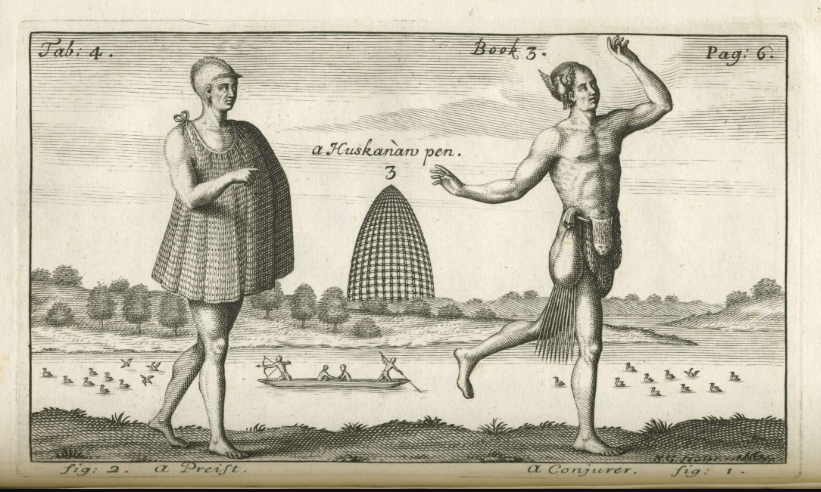
Engraving showing a Huskanaw pen; "Tab. 4 Is a Priest and a Conjurer in their proper Habits.", Simon Gribelin (1705) based on Theodor de Bry engravings (1590) of John White watercolors ca. 1585-1587 (Beverley 2006 {1705}: Book III, 6)
References
-
Beverley, R. (1705). The History and Present State of Virginia, in Four Parts. I. The History of the First Settlement of Virginia, and the Government thereof, to the present Time. II. The Natural Productions and Conveniencies of the Country, suited to Trade and Improvement. III. The Native Indians, their Religion, Laws, and Customs, in War and Peace. IV. The present State of the Country, as to the Polity of the Government, and the Improvements of the Land. By a Native and Inhabitant of the Place. London: R. Parker, the Unicorn. Retrieved from: https://archive.org/details/bim_eighteenth-century_the-history-and-present-_beverley-robert_1705/mode/2up.
-
Beverley, R. (2006). The History and Present State of Virginia, in Four Parts. I. The History of the First Settlement of Virginia, and the Government Thereof, to the present Time. II. The Natural Productions and Conveniencies of the Country, suited to Trade and Improvement. III. The Native Indians, their Religion, Laws, and Customs, in War and Peace. IV. The present State of the Country, as to the Polity of the Government, and the Improvements of the Land. By a Native and Inhabitant of the Place. Chapel Hill, NC: Documenting the American South (DocSouth), University of North Carolina at Chapel Hill University Library. (Original work published 1705). Retrieved from: https://docsouth.unc.edu/southlit/beverley/beverley.html.
-
Clayton, J. (1964). In B. G. Hoffman (Ed.), John Clayton’s 1687 Account of the Medicinal Practices of the Virginia Indians. Ethnohistory, 11 (1), 1-40. (Original work written ca. 1687.) Retrieved from: https://www.jstor.org/stable/480535.
-
Lawson, J. (1709). A New Voyage to Carolina; Containing the Exact Description and Natural History of that Country: Together with the Present State thereof. And a Journal Of a Thousand Miles, Travel'd thro' several Nations of Indians. Giving a particular Account of their Customs, Manners, &c. By John Lawson, Gent. Surveyor-General of North-Carolina. London. Retrieved from: https://archive.org/details/newvoyagetocarol00laws/page/n3/mode/2up.
-
Rountree, H. (1989). The Powhatan Indians of Virginia: Their Traditional Culture. Norman, OK: The University of Oklahoma Press.
-
Schultes, R. E., & Hofmann, A. (1979). Plants of the Gods: Origins of Hallucinogenic Use. New York: Alfred van der Marck Editions. Retrieved from: https://archive.org/details/plantsofgodsorig00schu/mode/2up.