Hours & Admissions
 Directions
Corn/Maize
Maize (Zea mays L.), or what is commonly called Corn in the United States, was and is one of the most important crops to come from the Americas and is one of, if not, the most prolific agricultural plants in the World. Maize/Corn is a species of grass in the Family Poaceae, just like wheat, barley, rice, oats, millet, rye, and other staple cereal crops.
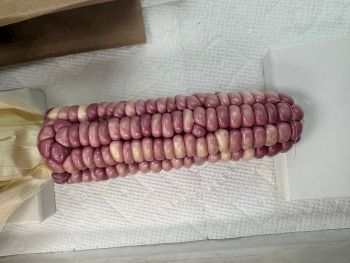
Ear of Tutelo Strawberry Corn grown in our VMNH R+C Greenhouse, click here to read our growing blog!
Originally domesticated in Mesoamerica, maize was spread via trade routes throughout North America, and was being grown along the modern Eastern Seaboard by the time of European colonization. The maize that was being grown in Tidewater Virginia by the Powhatan people at the time of the Jamestown Colony's founding in 1607 would most likely remind us of the kind of maize that is sold ornamentally in fall as 'Indian Corn' or sold as deer or animal feed. This Indigenous maize was not what we relish today during summer and fall as sweet corn on the cob, these types of maize were grown mainly as a food to be stored during the winter and so they had very hard kernels and required processing to consume.
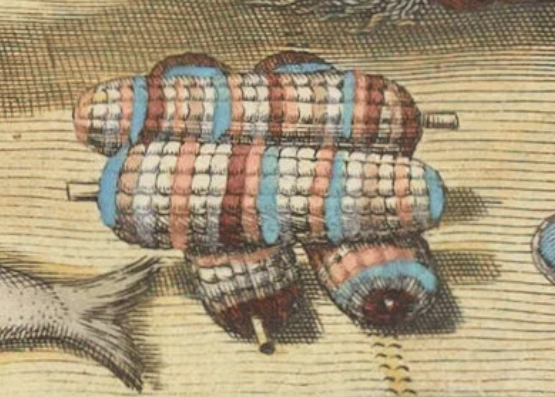
Multi-colored corn cobs, detail of colored engraving of "Their sitting at meate.", Theodor de Bry (1590) based on a John White watercolor ca. 1585-1587 (Hariot 1590 {1588}; Dukes 2024)
Indigenous people often prepared these kernels in ways that we might recognize today: usually grinding or pounding the kernels to make cornmeal for johnnycake-like bread, tamale-like dumplings boiled in corn husks, or a grits-like porridge. Also, the kernels could be treated in an alkaline solution of wood ash lye to make hominy through the process of nixtamalization; roasting or 'parching' the kernels as a traveling food was also common; certain varieties of kernels could also be roasted and popped as popcorn; the immature cobs were also picked and roasted and eaten like we would eat modern 'sweet corn' which was often part of a mid-summer Green Corn Festival to celebrate the season's bounty. Maize was also used in medicines by various Indigenous peoples and the stalks were sometimes juiced or drank from for the very sweet liquid sap they contained. European colonizers and immigrants as well as the enslaved African peoples they brought to North America all adopted maize as a staple food and used it in very similar ways as Indigenous peoples did. One way maize was used by Europeans that Indigenous peoples did not teach them or know about was the process of malting the corn kernels in order to brew ales and beer; Founding Father, author of the Declaration of Independence, and third President Thomas Jefferson brewed extensively with maize for home consumption at his Monticello plantation near Charlottesville and even recorded that "...during the revolutionary war, the brewers on James river used Indian corn almost exclusively of all other" (Jefferson 1815). In addition, the sweet corn sap was also used in brewing a beer akin to molasses or ginger beer.
Maize/Corn was one of the 'Three Sisters' of Indigenous agriculture, a system of companion planting practiced and perfected by numerous Indigenous cultures throughout Mesoamerica and North America for millennia. In the area encompassing the Eastern United States, archaeological evidence points to the beginning of 'Three Sisters' agriculture emerging via trade route-inspired diffusion in the Late Woodland Period, roughly around the year 1000 CE (Gremillion 1995: 12). Corn kernels were planted in mounds that were created in fire-cleared fields, often in clusters of up to four stalks or more. Among the growing corn stalks, seeds of climbing beans (Phaseolus vulgaris L.) would be sown, providing a sturdy trellis on which for them to climb, as well as bracing and helping the corn stalks remain upright in high winds. Corn plants are heavy nitrogen feeders, and beans just so happen to be nitrogen fixers via bacteria that colonize their root systems and sequester atmospheric nitrogen in the soil in usable forms like ammonia, which helps provide the nitrogen needed by corn plants. Pumpkins/Squashes/Gourds (Cucurbita spp. L. or Lagenaria siceraria (Molina) Standl.) would also be planted in between the corn mounds to provide shade to the soil with their large leaves in order to help the soil retain moisture and to shade out weedy species from being able to thrive (Marsh n.d.). The biological mechanisms of companion planting were unknown at the time, but the benefits were observed and refined by Indigenous peoples over thousands of years, oftentimes with them selectively breeding landrace, local varieties of these crops over long periods of time which were well-suited and adapted to the climates in which they lived. Indigenous corn varieties came in all sorts of colors, shapes, sizes, and ripening times and particular Indigenous groups often developed certain landrace varieties over time which came to be associated with their particular cultures, such as the type we are growing called Tutelo Strawberry Corn.
Tutelo Strawberry Corn (Zea mays L. 'Tutelo Strawberry') is one such landrace variety that was developed and grown for hundreds of years by the Tutelo, one of the Eastern Siouan peoples of the Piedmont region of Virginia and North Carolina. This variety was supposedly named for a Tutelo summer festival that occurred with the ripening of strawberries, or due simply to the vibrant red color of the corn kernels. A portion of the Tutelo eventually joined the Haudenosaunee (the Iroquois Confederacy) in the latter half of the 18th century in upper New York state. This corn variety was propagated for years afterwards by the Cornplanter Senecas of Warren County, Pennsylvania before being entrusted to a Quaker activist for preservation after the Cornplanter Tract reservation was flooded in the 1960s by the construction of the Kinzua Dam (Weaver 2012). This variety of corn was chosen primarily due to its important status to the Tutelo people of the Piedmont region of Virginia and North Carolina, as well as the fact that its growth habit is suitable for our greenhouse's size restrictions, namely that its height is only 4-to-6-feet or so at maturity instead of the 10-feet-or-taller height that some corn varieties can achieve.
Tutelo Strawberry Corn seeds were purchased online from Baker Creek Heirloom Seed Company located in Mansfield, MO.
Ethnohistorical Accounts
*NOTE: These quotations from early English colonists represent some of the only information written down about Indigenous and African lifeways in Eastern North America. However, it must be specified that they represent biased and oftentimes prejudiced observations and worldviews and should be regarded as interpretations of how Indigenous and enslaved African people lived and not exclusively as fact.
-
"Pagatowr, a kinde of graine so called by the inhabitants; the same in the West Indies is called Mayze... The graine is about the bignesse of our ordinary English peaze and not much different in forme and shape: but of diuers colours: some white, some red, some yellow, and some blew. All of them yeelde a very white and sweete flowre: beeing vsed according to his kinde it maketh a very good bread. Wee made of the same in the countrey some mault, whereof was brued as good ale as was to bee desired. So likewise by the help of hops therof may bee made as good Beere. It is a graine of marueilous great increase; of a thousand, fifteene hundred and some two thousand fold. There are three sortes, of which two ripen in an eleuen and twelue weekes at the most: sometimes in ten, after the time they are set, and are then of height in stalke about sixe or seuen foote. The other sort is ripe in fourteene, and is about ten foote high, of the stalkes some beare foure heads, some three, some one, and two: euery head containing fiue, sixe, or seuen hundred graines within a fewe more or lesse. Of these graines besides bread, the inhabitants make victuall eyther by parching them; or seething them whole vntill they be broken; or boyling the floure with water into a pappe" (Hariot 1590: 13-14).
-
"Then their setting or sowing is after this maner. First for their corne, beginning in one corner of the plot, with a pecker they make a hole, wherein they put foure graines with that care they touch not one another, (about an inch asunder) and couer them with the moulde againe: and so through out the whole plot, making such holes and vsing them after such maner: but with this regard that they bee made in rankes, euery ranke differing from other halfe a fadome or a yarde spare ground betwene euery hole: where according to discretion here and there, they set as many Beanes and Peaze: in diuers places also among the seedes of Macóqwer..." (Hariot 1590: 15).
-
"The greatest labour they take, is in planting their corne, for the Country naturally is overgrowne with wood. To prepare the ground they bruise the barke of the trees neare the root, then doe they scortch the roots with fire that they grow no more. The next yeare with a crooked peece of wood they beat up the weeds by the rootes, and in that mould they plant their Corne. Their manner is this. They make a hole in the earth with a sticke, and into it they put foure graines of wheate [maize] and two of beanes. These holes they make foure foote one from another; Their women and children do continually keepe it with weeding, and when it is growne middle high, they hill it about like a hop-yard... Every stalke of their corne commonly beareth two ears, some three, seldome any foure, many but one, and some none. Every eare ordinarily hath betwixt 200 and 500 graines. The stalke being greene hath a sweet juice in it, somewhat like a sugar Cane, which is the cause that when they gather their corne greene, they sucke the stalkes... Their corne they rost in the eare greene, and bruising it in a morter of wood with a Polt, lap it in rowles in the leaves of their corne, and so boyle it for a daintie... Their old wheat [maize] they first steepe a night in hot water, in the morning pounding it in a morter. They use a small basket for their Temmes, then pound againe the great, and so separating by dashing their hand in the basket, receive the flower in a platter made of wood... Tempering this flower with water, they make it either in cakes, covering them with ashes till they be baked, and then washing them in faire water, they drie presently with their owne heat: or else boyle them in water, eating the broth with the bread which they call Ponap. The groutes and peeces of the cornes remaining, by fanning in a Platter or in the wind away the branne, they boyle 3 or 4 houres with water, which is an ordinary food they call Ustatahamen" (Smith 1907 {1624}: 58-59).
-
"This Indian Corn was the Staff of Food, upon which the Indians did ever depend... There are Four Sorts of Indian Corn, Two of which are early ripe, and Two, late ripe; all growing in the same manner... oftentimes the Increase of this Grain amounts to above a Thousand for one... The late ripe Corn is diversify'd by the Shape of the Grain only, without any Respect to the accidental Differences in Colour, some being blue, some red, some yellow, some white, and some streak'd. That therefore which makes the Distinction, is the Plumpness or Shrivelling of the Grain; the one looks as smooth, and as full as the early ripe Corn, and this they call Flint-Corn; the other has a larger Grain, and looks shrivell'd with a Dent on the Back of the Grain, as if it had never come to Perfection; and this they call She-Corn...All these Sorts are planted alike, in Rows, Three, Four or Five Grains in a Hill, the larger sort at Four or Five Foot Distance, the lesser Sort nearer. The Indians used to give it One or Two Weedings, and make a Hill about it, and so the Labour was done. They likewise plant a Bean in the same Hill with the Corn, upon whose Stalk it sustains it self...whence they had their Indian Corn, I can give no Account; for I don't believe that it was spontaneous* [(*native)] in those Parts" (Beverley 1705: Book II, 28-30).
-
"The Indian Corn, or Maiz, proves the most useful Grain in the World; and had it not been for the Fruitfulness of this Species, it would have proved very difficult to have settled some of the Plantations in America. It is very nourishing, whether in Bread, sodden, or otherwise; and those poor Christian Servants in Virginia, Maryland, and the other northerly Plantations, that have been forced to live wholly upon it, do manifestly prove, that is is the most nourishing Grain, for a Man to subsist on, without any other Victuals. And this Assertion is made good by the Negro-Slaves, who, in many Places, eat nothing but this Indian-Corn and Salt... It refuses no Grounds, unless the barren Sands, and when planted in good Ground, will repay the Planter seven or eight hundred fold; besides the Stalks bruis'd and boil'd, make very pleasant Beer, being sweet like the Sugar-Cane" (Lawson 1709: 75).
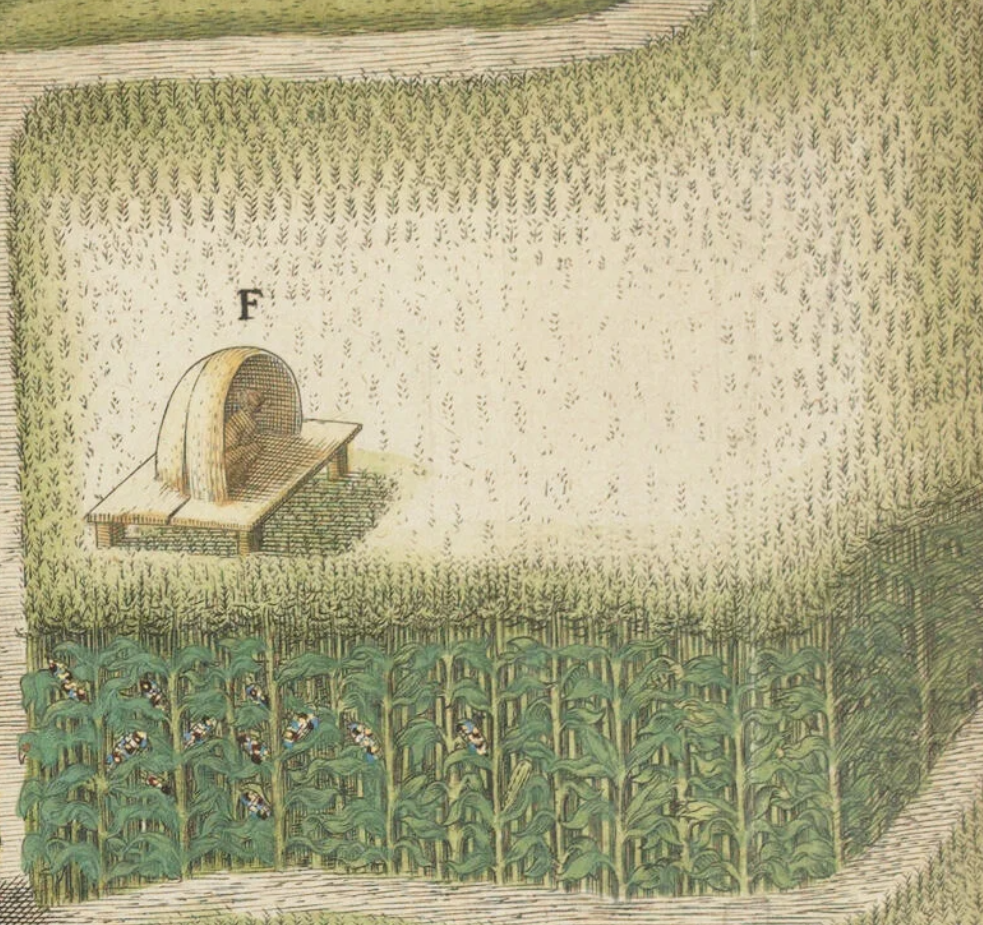
Ripe corn field, detail of colored engraving of "The Tovvne of Secota.", Theodor de Bry (1590) based on a John White watercolor ca. 1585-1587 (Hariot 1590 {1588}; Dukes 2024)
References
-
Baker Creek Heirloom Seed Company. (n.d.). Corn Seeds, Tutelo Strawberry. Retrieved from: https://www.rareseeds.com/corn-seeds-tutelo-strawberry.
-
Beverley, R. (1705). The History and Present State of Virginia, in Four Parts. I. The History of the First Settlement of Virginia, and the Government thereof, to the present Time. II. The Natural Productions and Conveniencies of the Country, suited to Trade and Improvement. III. The Native Indians, their Religion, Laws, and Customs, in War and Peace. IV. The present State of the Country, as to the Polity of the Government, and the Improvements of the Land. By a Native and Inhabitant of the Place. London: R. Parker, the Unicorn. Retrieved from: https://archive.org/details/bim_eighteenth-century_the-history-and-present-_beverley-robert_1705/mode/2up.
-
Dukes, H. (2024) Theodor de Bry’s Engravings for Thomas Harriot’s Briefe and True Report (1590). The Public Domain Review. Retrieved from: https://publicdomainreview.org/collection/briefe-and-true-report-de-bry-engravings/.
-
Gremillion, K. J. (1995). “Comparative Paleoethnobotany of Three Native Southeastern Communities of the Historic Period.” Southeastern Archaeology 14 (1), 1-16. Retrieved from https://www.jstor.org/stable/40713027.
-
Hariot, T. (1590). A briefe and true report of the new found land of Virginia, of the commodities and of the nature and manners of the naturall inhabitants. Discouered by the English Colony there seated by Sir Richard Greinuile Knight In the yeere 1585. Which Remained vnder the gouernement of twelve monethes, At the speciall charge and direction of the Honourable SIR WALTER RALEIGH Knight lord Warden of the Stanneries Who therein hath been fauoured and authorised by her MAIESTIE and her letters patents: This fore booke Is made in English BY Thomas Hariot Servant to the abouenamed Sir WALTER, a member of the Colony, and there imployed in discouering. T. de Bry & G. van Veen (Engravers). Frankfurt am Main: Johann Wechel. In Library of Congress Online Catalog. (Original work published 1588). Retrieved from: https://www.loc.gov/item/48032384/.
-
Jefferson, T. (1815). Thomas Jefferson to Joseph Coppinger, 25 April 1815. Founders Online. National Archives. Retrieved from: https://founders.archives.gov/documents/Jefferson/03-08-02-0350. [Original source: The Papers of Thomas Jefferson. (2011). Retirement Series, vol. 8: 438-439. 1 October 1814 to 31 August 1815. (J. Jefferson Looney, Ed.). Princeton University Press, Princeton.].
-
Lawson, J. (1709). A New Voyage to Carolina; Containing the Exact Description and Natural History of that Country: Together with the Present State thereof. And a Journal Of a Thousand Miles, Travel'd thro' several Nations of Indians. Giving a particular Account of their Customs, Manners, &c. By John Lawson, Gent. Surveyor-General of North-Carolina. London. Retrieved from: https://archive.org/details/newvoyagetocarol00laws/page/n3/mode/2up.
-
Marsh, E. (n.d.). The Three Sisters of Indigenous American Agriculture. U. S. Department of Agriculture, National Agricultural Library. Retrieved from: https://www.nal.usda.gov/collections/stories/three-sisters.
-
Smith, J. (1907). The Generall Historie of Virginia, New-England, & The Summer Isles Together with The True Travels, Adventures and Observations, and A Sea Grammar By Captaine John Smith Sometymes Governour in those Countryes and Admirall of New England. (Vol. 1). Glasgow: The University of Glasgow Press, by James MacLehose and Sons. (Original work published 1624). Retrieved from: https://archive.org/details/generallhistorie01smit/page/n7/mode/2up.
-
Weaver, W. W. (2012). "The Preservation of Strawberry Corn". Mother Earth Gardener. Retrieved from: https://www.motherearthgardener.com/plant-profiles/strawberry-corn-zmaz12uzfol/.