Hours & Admissions
 Directions
Sacred Tobacco
One of the most important religious and spiritual plants which was renowned by the Indigenous peoples of Virginia was Sacred Tobacco (Nicotiana rustica L.), a member of the nightshade family (Family Solanaceae). It remains one of the most important plants for many Indigenous groups today just as it was for Indigenous peoples in the past, being used by groups from North America to South America in vital religio-cultural and socio-cultural contexts (Grechanik n.d.). Sacred Tobacco (also known variously as Aztec Tobacco, Indian Tobacco, Mapacho, Apooke, etc.) was utilized as a potent plant medicine that was believed to treat a variety of ailments of both body and mind, it was a divine plant used as a religious offering to deities, was offered to deities to bring good fortune and to ward off bad events like storms, and was a vital social connector used to mark special occasions such as rituals, treaties, or victories. Sacred Tobacco likely originated in Mesoamerica and spread via vast and interconnected trade routes throughout the Americas.
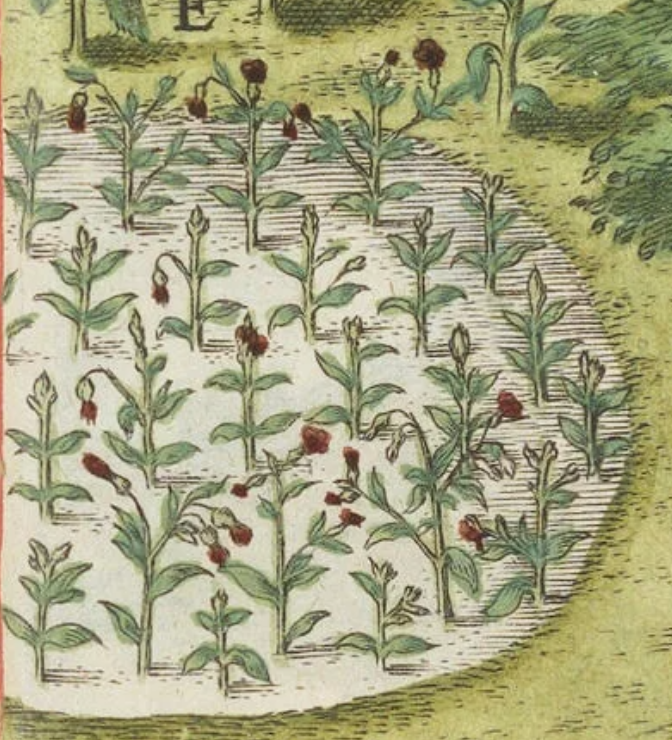
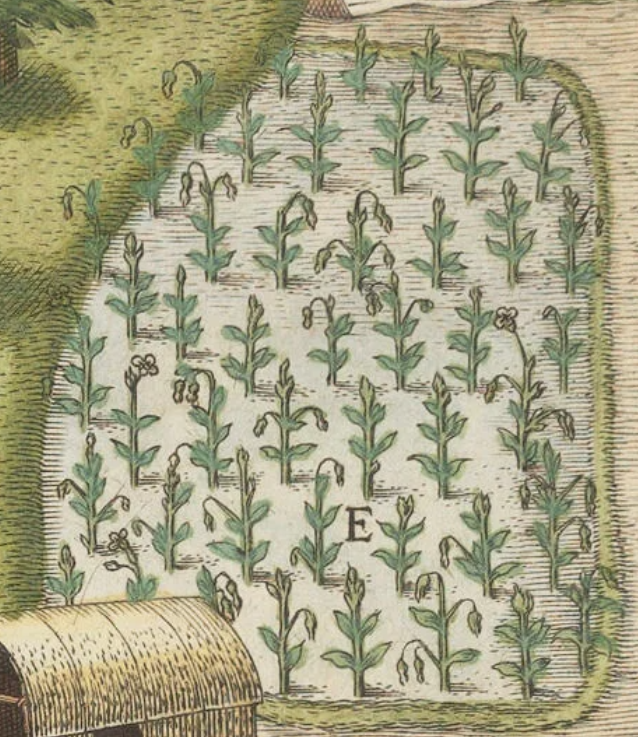
Details of tobacco patches in the colored engraving of "The Tovvne of Secota.", Theodor de Bry (1590) based on a John White watercolor ca. 1585-1587 (Hariot 1590 {1588}; Dukes 2024)
Sacred Tobacco was typically sun-dried or smoke-cured and was cured 'green', not intricately fermented or aged like modern smoking and chewing tobacco often is. It was smoked by the Indigenous peoples of Virginia through pipes made of clay, but it was also sprinkled on fires or thrown into the air or water, or onto a newly made structure like a fish weir, as an offering to a deity to ward off misfortune like storms or to bring good fortune like bountiful harvests.
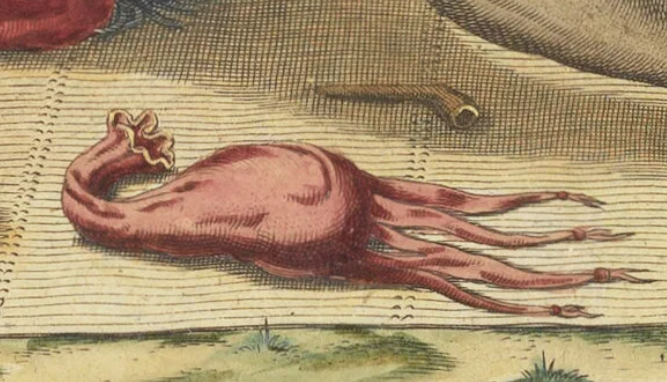
Detail of a tobacco pipe and pouch in the colored engraving of "Their sitting at meate.", Theodor de Bry (1590) based on a John White watercolor ca. 1585-1587 (Hariot 1590 {1588}; Dukes 2024)
Though Sacred Tobacco is grown in certain parts of the world today for commercial tobacco products, its incredibly high, naturally-occurring nicotine content (as much as 9% or more by dry weight), small leaves, and vigorously suckering habit has made it less desirable than Common Tobacco (N. tabacum L.) for agriculture. Common Tobacco is the species that was a vital export for the Habsburgian Spanish Empire from their Caribbean and South American colonies and was the species that Jamestown colonist John Rolfe surreptitiously procured from either Trinidad or the Orinoco River basin in spite of a Spanish ban on the sale of tobacco seeds to non-Spanish foreigners. He first cultivated Common Tobacco at Jamestown in 1613 to export to England to help save the fledgling and financially struggling Virginia Colony, producing a tobacco that soon captivated England and later the world. Compared to Sacred Tobacco, Common Tobacco only has a nicotine content by dry weight of 1-3% and is the primary species grown for commercial and highly addictive tobacco products today, contributing to a large number of major, preventable, adverse health outcomes worldwide. Sacred Tobacco (and Common Tobacco for that matter) was never intended by Indigenous peoples to be used recreationally or for profit as tobacco is today; tobacco's biopiracy, commercialization, and misuse works to strip a revered plant of its spiritual and cultural importance (Salmon 2020; Wike 2020; Sutton 2025).
The variety of Sacred Tobacco growing in the greenhouse is not known to us by a distinct cultivar or varietal name, but the seeds were received from Wood Thrush Native Nursery in Floyd, VA.
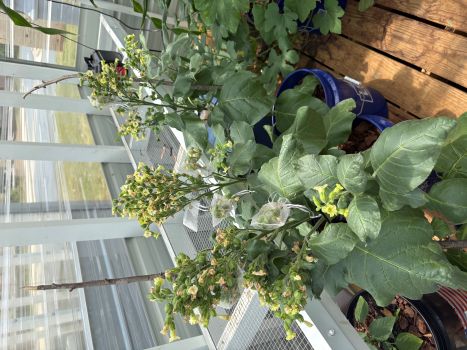
Sacred Tobacco plants being grown in our VMNH R+C Greenhouse, click here to read our growing blog!
Ethnohistorical Accounts
*NOTE: These quotations from early English colonists represent some of the only information written down about Indigenous lifeways in Eastern North America. However, it must be specified that they represent biased and oftentimes prejudiced observations and worldviews and should be regarded as interpretations of how Indigenous people lived and not exclusively as fact. Any health information or promotion of tobacco use presented by these writers exists in a contemporaneous and historical understanding that we today know is unequivocally false; recreational tobacco and nicotine use is highly deleterious to human health.
-
"There is an herbe which is sowed a part by it selfe & is called by the inhabitants Vppówoc: In the West indies it hath diuers names, according to the seuerall places & countries where it groweth and is vsed: The Spaniardes generally call it Tobacco. The leaues thereof being dried and brought into powder: they vse to take the fume or smoke thereof by sucking it through pipes made of claie into their stomacke and heade; from whence it purgeth superfluous fleame & other grosse humors, openeth all the pores & passages of the body: by which meane, the vse thereof, not only preserueth the body from obstructions; but also if any be, so that they haue not beene of too long continuance, in short time breaketh them: wherby their bodies are notably preserued in health, & know not many greeuous diseases wherewithall wee in England are oftentimes afflicted. This Vppówoc is of so precious estimation amongest then [sic], that they thinke their gods are maruelously delighted therwith: Wherupon sometimes they make hallowed fires & cast some of the pouder therein for a sacrifice: being in a storme vppon the waters, to pacifie their gods, they cast some vp into the aire and into the water: so a weare for fish being newly set vp, they cast some therein and into the aire: also after an escape of danger, they cast some into the aire likewise: but all done with strange gestures, stamping, somtime dauncing, clapping of hands, holding vp of hands, & staring vp into the heauens, vttering therewithal and chattering strange words & noises" (Hariot 1590 {1588}: 16).
-
"There is here great store of tobacco, which [they] call apooke; howbeit yt is not of the best kynd, yt is but poore and weake, and of a byting tast, yt growes not fully a yard above ground, bearing a little yellowe flower, like to hennebane, the leaves are short and thick, somewhat round at the upper end; whereas the best tobacco of Trynidado and the Oronoque is large, sharpe, and growing two or three yardes from the ground, bearing a flower of the bredth of our bellflowers in England: [they] ...dry the leaves of this apooke over the fier, and sometymes in the sun, and crumble yt into poulder, stalks, leaves, and all, taking the same in pipes of earth, which very ingeniously they can make. We observe that those Indians which have one, twoo, or more women, take much,--but such as yet have no appropriate woman take little or none at all" (Strachey 1849 {1619}: 121-122).
-
"They have also certaine Altar stones they call Pawcorances, but these stand from their Temples, some by their houses, others in the woods and wildernesses, where they have had any extraordinary accident, or incounter. And as you travell, at those stones they will tell you the cause why they were erected, which from age to age they instruct their children, as their best records of antiquities. Upon these they offer bloud, Deere suet, and Tobacco. This they doe when they returne from Warres, from hunting, and upon many other occasions. They have also another superstition that they use in stormes, when the waters are rough in the Rivers and Sea coasts. Their Conjurers runne to the water sides, or passing in their boats, after many hellish outcryes and invocations, they cast Tobacco, Copper, Pocones* [(*a red dye)], or such trash into the water, to pacifie that God whom they thinke to be very angry in those stormes... They thinke that their Werowances [chiefs] and Priests which they also esteeme Quiyoughcosughes [cockarouses?], when they are dead, doe goe beyond the mountaines towards the setting of the sunne, and ever remaine there in forme of their Okee, with their heads painted with oyle and Pocones, finely trimmed with feathers, and shall have beads, hatchets, copper, and Tobacco, doing nothing but dance and sing, with all their Predecessors..." (Smith 1907 {1624}: 74-76).
-
"How the Indians order'd their Tobacco, I am not certain, they now depending chiefly upon the English for what they smoak: But I am inform'd they used to let it all run to Seed, only succouring the Leaves, to keep the Sprouts from growing upon, and starving them; and when it was ripe, they pull'd off the Leaves, cured them in the Sun, and laid them up for Use. But the Planters make a heavy Bustle with it now, and can't please the Market neither" (Beverley 1705: Book II, 30).
-
"Their Teeth are yellow with Smoaking Tobacco, which both Men and Women are much addicted to. They tell us, that they had Tobacco amongst them, before the Europeans made any Discovery of that Continent. It differs in the Leaf from the sweet-scented and Oroonoko, which are the Plants we raise and cultivate in America. Theirs differs likewise much in the Smell, when green, from our Tobacco, before cured. They do not use the same way to cure it as we do; and therefore, the Difference must be very considerable in Taste; for all Men (that know Tobacco) must allow, that it is the Ordering thereof which gives a Hogoo* [(*a strong flavor or smell)] to that Weed, rather than any Natural Relish it possesses, when green. Although they are great Smokers, yet they never are seen to take it in Snuff, or chew it" (Lawson 1709: 172-173).
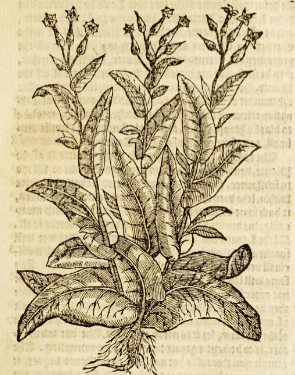
Engraving of Common Tobacco (Nicotiana tabacum L.) by John Frampton(?) in Monardes (1580 {1577}: Fol. 34)
References
-
Beverley, R. (1705). The History and Present State of Virginia, in Four Parts. I. The History of the First Settlement of Virginia, and the Government thereof, to the present Time. II. The Natural Productions and Conveniencies of the Country, suited to Trade and Improvement. III. The Native Indians, their Religion, Laws, and Customs, in War and Peace. IV. The present State of the Country, as to the Polity of the Government, and the Improvements of the Land. By a Native and Inhabitant of the Place. London: R. Parker, the Unicorn. Retrieved from: https://archive.org/details/bim_eighteenth-century_the-history-and-present_beverley-robert_1705/mode/2up.
-
Dukes, H. (2024) Theodor de Bry?s Engravings for Thomas Harriot?s Briefe and True Report (1590). The Public Domain Review. Retrieved from: https://publicdomainreview.org/collection/briefe-and-true-report-de-bry-engravings/.
-
Grechanik, J. (n.d.). Tobacco/Diets. Nicotiana Rustica. Retrieved from: https://nicotianarustica.org/tobacco.
-
Hariot, T. (1590). A briefe and true report of the new found land of Virginia, of the commodities and of the nature and manners of the naturall inhabitants. Discouered by the English Colony there seated by Sir Richard Greinuile Knight In the yeere 1585. Which Remained vnder the gouernement of twelve monethes, At the speciall charge and direction of the Honourable SIR WALTER RALEIGH Knight lord Warden of the Stanneries Who therein hath been fauoured and authorised by her MAIESTIE and her letters patents: This fore booke Is made in English BY Thomas Hariot Servant to the abouenamed Sir WALTER, a member of the Colony, and there imployed in discouering. T. de Bry & G. van Veen (Engravers). Frankfurt am Main: Johann Wechel. In Library of Congress Online Catalog. (Original work published 1588). Retrieved from: https://www.loc.gov/item/48032384/.
-
Lawson, J. (1709). A New Voyage to Carolina; Containing the Exact Desription and Natural History of that Country: Together with the Present State thereof. And a Journal of a Thousand Miles, Travel'd thro' several Nations of Indians. Giving a particular Account of their Customs, Manners, &c. London. Retrieved from: https://archive.org/details/newvoyagetocarol00laws/page/n3/mode/2up.
-
Monardes, N. (1580). Ioyfvll Newes out of the newfound world, wherein are declared the rare and singular vertues of diuers and sundrie Herbs, Trees, Oyles, Plants, & Stones, with their applications, aswell to the vse of Phisicke, as Chirurgery: which being wel applied, bring such present remedy for all Diseases, as may seeme altogether incredible: notwithstanding by practize found out to be true. Also the portrature of the sayed Herbes, very aptly described: Englished by Iohn Frampton Merchant. Newly corrected as by conference with the olde copies may appeare. Whereunto are added three other bookes treating of the Bezaar stone, the herbe Escuerçonera, the properties of yron and steele, in Medicine and the benefite of snowe. (J. Frampton, Trans.). London: William Norton. (Original work published 1577). Retrieved from: https://archive.org/details/ioyfullnewesouto00mona/page/n3/mode/2up.
-
Rountree, H. (1989). The Powhatan Indians of Virginia: Their Traditional Culture. Norman, OK: The University of Oklahoma Press.
-
Salmon, E. J. (2020). John Rolfe (d. 1622). Encyclopedia Virginia. Retrieved from: https://encyclopediavirginia.org/entries/rolfe-john-d-1622/#:~:text=The%20following%20year%2C%20Rolfe%20began,where%20he%20reportedly%20held%20property.
-
Smith, J. (1907). The Generall Historie of Virginia, New-England, & The Summer Isles Together with The True Travels, Adventures and Observations, and A Sea Grammar By Captaine John Smith Sometymes Governour in those Countryes and Admirall of New England. (Vol. 1). Glasgow: The University of Glasgow Press, by James MacLehose and Sons. (Original work published 1624). Retrieved from: https://archive.org/details/generallhistorie01smit/page/n7/mode/2up.
-
Strachey, W. (1849). The Historie of Travaile into Virginia Britannia; Expressing the Cosmographie and Comodities of the Country, Togither with the Manners and Customes of the People. (R. H. Major, Ed.). London: The Hakluyt Society (Original work published 1619). Retrieved from: https://archive.org/details/historietravail00majogoog/mode/2up?q=yard.
-
Sutton, V. (2025). The Biopiracy of Tobacco. Native News Online. Retrieved from: https://nativenewsonline.net/opinion/the-biopiracy-of-tobacco/.
-
Wike, A. (2020). The History of Nicotiana Rustica. Smoking Pipes [blog post]. Retrieved from: https://www.smokingpipes.com/smokingpipesblog/single.cfm/post/the-history-nicotiana-rustica.